
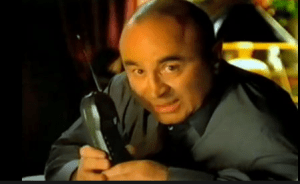
Bob knows a thing…
The terrifying, if inevitable revelation that money expert Martin Lewis has been doppelganged, an online artificial intelligence (AI) likeness designed to defraud the millions of us who trust the media’s most respected economic adviser, was a wake up call to the slew of fake AI films heading our way. This the latest and to date most sophisticated means of persuading innocent internet users to hand money over to invisible criminals.
The very next morning after the Martin Lewis story I received a spurious email; I was averaging around 80 scam emails a day earlier in the year. Bearing the familiar GOV.UK DVLA logo at the top of the page it stated that my bank had twice declined direct debit payments owing for a year of road tax. If I wasn’t such a cynical doomster I might have panicked hit the link and paid through the nose because my road tax is due for renewal fairly soon. Unless there is one hiding in my filing cabinet how internet criminals know this is beyond me?
I have my own rather limited system for spotting fraud emails that while not especially sophisticated – does the job. Without clocking on any highlighted nee coloured word or address in the email text and thereby inviting an invasion of not so delicious cookies and other unpleasant digital devices I position my laptop cursor directly above the very end of the sender’s name at the top of the email. Highlighting the name and clicking again reveals the actual email address it originated from. In this case an address without the slightest mention of anything to do with gov.uk. With the true address exposed and the box now open there is the opportunity to ‘block’ the contact/sender. This works for some scam addresses but as we know criminals possess the annoying ability of always being one step ahead. Many scam emails now have addresses with multiple digits in them. Block one and numerical code has the ability to self generate another number and address similar but not quite the same in order to get past the ‘block contact’ instruction.’.
The crime both were aiming for is called Authorised Push Payment (APP) that last year yielded criminals, organised or otherwise, £1.2 billion according to UK Finance. In all probability the amount stolen by this means is almost certainly much higher but banks are famously reluctant to own up to exactly how much an online world they are partly responsible for is really costing them and us. Another report puts the figure £1 billion higher.
Infact I have a second method of decoding questionable emails from financial institutions. It’s in the verbiage that from the real deal, all my banks and credit card companies, is painfully pseudo hip. For instance when being reminded to pay my credit card bill the SMS text reads ‘heads up’! Clearly being down in the hood with the kids is the current on trend method of identifying with 21st century customers. But if ‘heads up’ isn’t bad enough how’s this for a reaction to the possibility that the outstanding bill had already been paid: ‘Nice one’. Or another bank that emailed ‘oops – that doesn’t seem right’ in response to a log in. Oops!
Digging deeper reveals that three quarters of all those APP frauds began on social media, the online platforms that I will have nothing to with but which millions trust and use and share gossip and family photographs and worryingly receive increasing amounts of what is deemed trustworthy news. Why? Because it’s free. Or is it?
It may not seem like a lot but 18% of APP frauds start via telecommunications; emails, SMS texts, phone calls. I received a call from someone who sounded if they were in a different solar system and claiming to be employed by Google Security warning me that someone had accessed my computer hard drive and if they weren’t gotten rid of asap would wreak financial havoc on me. All I had to do was allow him access to my computer. After initially going on with the spiel I called him my favourite swear word beginning with a c, told him to fuck off and hung up. He called back about 30 seconds later and told me “no, you’re the c***.”
Then just last month I bought, or though I bought, a bicycle repair stand via a site on ebay. The ad featured the same bicycle stand photograph used by other sellers, only the one I selected, based on reviews, was much cheaper. Doh! When the package finally arrived my bicycle repair stand turned out to be a plastic parts shelf that fits on the stand, should I be lucky enough to own one.
Would you believe it whilst writing this another scam email has dropped in stating that my bank account will be debited a lot of US dollars for – enjoy the irony – internet security.
It was announced this week that over 1000 railway ticket offices are to be closed thereby pushing all railway users, except those near city terminuses, to buy their tickets online. There are already fake bank, passport, pension, funeral, and of course DVLA car tax sites. How many fake train travel ticket sites can we expect?
I don’t recall anyone being defrauded when they visited their local bank, or renewed their passport and car tax at the post office, or spoke on the telephone to work and pensions and funeral services. In the words of Bob Hoskins in those 1990s television advertisements for BT – “it’s good to talk.”
So here’s a thought. High Streets are imploding all over the country because ever more of us are shopping and banking and investing and socialising and being ripped off online to the tune of £1.2 billion a year. So don’t do it. Do our shopping in shops! Don’t use free social media, make that call and drop friends a line; paper, envelope and stamp. Talk to people face to face in the high street, in the post office, in the shops, and in the pubs. Sounds like science fiction. Maybe, but who knows, it could catch on.
 jonathan futrell