
What is it with corduroy? Why after over 100 years since emerging as the worker’s ‘poor man’s velvet’ is it still so contentious? Is it in or is it out? Is it cool or is it beyond naff? Is it the fabric equivalent of Marmite?
Denim recovered from being work wear – it may even be the most fashionable fabric on the plant – but corduroy drifts in and out of the periphery of style like cowboy boots and cravats, reviled and loved in unequal measure.
I am writing this because some comments, in fairness some of which were approving, about a blue corduroy bomber style jacket given to me some years ago by Bob Elms because he found himself with two identical garments, reminded me of the remarks I frequently fended off pertaining to earlier corduroy jackets I’ve owned and frankly wish I still possessed today.
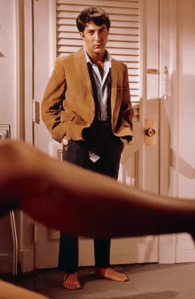
Hoffman doing ok in corduroy
I recall variously being described as a geography teacher and librarian after my mother, a woman with a keen eye for style, kitted me out in what would now be described as a chore style dark green corduroy jacket. It didn’t seem to matter nor occur to any of its deprecators that celebrities from Paul Newman and Robert Redford to Mick Jagger, Elton John and The Beatles, (the Fab Four once celebrated for ‘saving the British cord industry’) are all considered legendary corduroy aficionados. Most of them, like Dustin Hoffman in The Graduate, photographed in geography teacher green or brown corduroy. Jagger the exception photographed by Cecil Beaton in a pair of pink – think Barbie – cords.
The Daily Telegraph, a newspaper not known for its cutting edge fashion sense (believe it or not I once wrote a monthly DIY column for it, not in corduroy) once described corduroy as the fabric of “left leaning polytechnic lecturers in sandals,” which sounds pretty cool although I suspect wasn’t meant to be. Although I do a bit understand the teacher/professor connection having been taught history by an unkempt such a person with curly black Peter Green locks. He wore a lot of corduroy beneath his professorial black cape, slacks and jacket in different colours, teamed with dark blue shirts that he wore, when asked, “because they don’t show the dirt and the trousers don’t need pressing.” Not a strong case for corduroy I grant you merely underlining a perception of dusty libraries and slovenly professor with elbow patches.” In fact, I adore elbow patches but that’s another story.
The other inexplicable beef with corduroy is noise. That’s right – sound. You know, loud and distracting. I’ve had issues with nylon anoraks, a swishing fish tail parka and steel toe caps but I can put my hand on my heart and confess I’ve never heard any sound, tone or decibel from any of my corduroy garments – jackets, jeans, shirts or cap.
Among the litany of magazines and periodicals warning on the do’s and don’t of corduroy GQ says “despite the verticality of the stripes corduroy will make you look like a sausage and the sound of your legs rubbing together may invite violence on your person.”
Not in all the weeks of I’ll never remember what’s his name’s name standing before us and waving his arms and writing on the blackboard neither I nor either of the two remaining school friends I have from that time can recall any noise emanating from his unclean and un-ironed corduroy gear.
Returning to the baseball cap for a paragraph another of those we all hate corduroy article states that under no circumstances should anyone wear a corduroy hat. Mine, Kim bought from TKMaxx so it was cheap. It’s a Ralph Lauren, the US label that makes terrific corduroy clothes with that Ivy League cut; an English gentleman look with a street twist.
So what is corduroy anyway? Where is it from, and how did it acquire its name? There is an apocryphal tale that it is indeed French, aka cord du roi, the cord of the king. Wishful thinking perhaps by corduroy makers hoping to get beyond class prejudice. It has a more melodious name in Italy where it is velluto a coste, that of course translates into velvet with a rib in a country where fashion designers can’t get enough of the ribbed textile with an endemic velvety weft.
The coarse ancestor of corduroy was a sturdy workwear known as duroy emerging in the UK in the 18th century and known in European textile circles as the Manchester or Bedford cloth. It did and does comprise rows of tufted wales – a term used for rows in knitting. Early versions of wales were painstakingly cut by hand and thereafter brushed to raise a pile. The number of wales per inch dictates the size of the cord; the lower the number of wales per inch the thicker the cord. A low number of fat wales is sometimes known as ‘elephant’ cord and is strictly casual whereas a high number of wales are found in finer ‘needle’ cord for a smarter appearance. I am strictly an ‘elephant’ and rhino (!) corduroy man.
It’s been up and down for corduroy since first and briefly being taken seriously in the 1960s. Peaking in the 1970s it enjoyed a reboot in the 1990s when Pearl Jam recorded a tune entitled, you guessed it, Corduroy and Pulp’s Jarvis Cocker, a Top 40 epitome of a left leaning polytechnic lecturer, was seldom seen out of it, the fabric!
For all the mocking it being the poor man’s velvet I like duroy because in my book it is the most smart/casual fabric a man can wear with the shifting nap but none of the dressiness of the costlier fabric it is meant to imitate. Clobber with an endemic softness that bestow the wearer with smartness devoid of stuffiness. A cut above casual and a snip below salary man that, like denim, really does improve with wear and age. It took my fourth corduroy jacket, a Stephanano Veneziani bought in Florence ( dark brown, mid-wale, three button with sewn in back belt and single vent) all of five years to sag into that comfortable body hugging droop I love but which I suspect the fashion writers despair of. My newest (my seventh to date), also Italian and also brown, has chunkier wales with a saggy worn in smart but casual style sewn into it. I think.
In any doubt that corduroy is back, for however long, take a look at this year’s Brunello Cucinelli collection with an ocean of wales of every size, weft and colour. The Guardian now proclaiming it’s ‘comfy, cosy and clever, Gentleman’s Journal declaring corduroy is officially cool again and Harper’s Bazaar touting corduroy jackets, baseball caps and even combat boots.
If you like your clothes to be a talking point – look no further.
 jonathan futrell