I remember monkey bottles, kangaroo tails, and Frank Ifield


Frank then…

I am fortunate to have worked through a period in journalism when the gifts, the perks – the freebies to apply the correct journalistic parlance – were worth having. My diary is housed within a handsome Papyrus leather book jacket that has aged like a pair of vintage Levis, and my grey Rob The Traveller Millican canvas shoulder bag is seldom out of reach.

monkey business

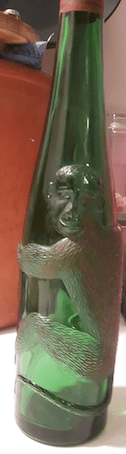
Thinking back it cannot have been so munificent during my father’s time on Fleet Street in the early 1960s. The concept of PR and companies buying their way into favour hadn’t gotten a hold. In fact the only things I can remember not being paid for, but which were pride of place in the front room of our Whitton home, were a bottle of red wine with a forearm sized golden glass monkey clinging to its outside, and a clear glass jar of kangaroo tail soup: thumb sized cross-sections of furry bits of meat revealed when it was shaken.

Both the wine and the soup were presented to my father by a spirited Australian country singer named Frank Ifield who in 1959 had moved to London from his native Sydney. It was a canny move resulting in four UK number one singles and a career that stumbles on to this day. 

Arguably his biggest hit was I Remember You, a rousing country/pop classic, that held the number one spot for seven weeks in the summer of 1962. With a thick quiff of light brown hair, high cheekbones, and an easy smile,  Frank’s blend of singing and yodelling – that’s right, Alpine style yodelling – proved irresistible. I Remember You was followed in October of that year with the double A side chart topper, Hank Williams’  Lovesick Blues with She Taught Me How To Yodel on the flip.

My father, himself a wicked boogie woogie piano player, was the chief sub editor of The Daily Mirror and a close friend of the paper’s pop writer, Pat Doncaster, (incidentally the man who gave me my first long playing record, The Beatles’ Hard Days Night). My father interviewed Frank for the paper who showed his appreciation with the wine and the soup, and a signed photograph of himself that I seem to recall was taken on the street close to the new Daily Mirror building at Holborn Circus. 

Fast forward over 50 years to a Friday evening a month ago and a friend’s house here in Padstow’s old town, close to where I now live. On the top shelf  in an alcove in a kitchen, where five or six of us are pre-loading and watching clips of 1970s soul bands on a smart phone belonging to a retired Fleet Street sub editor, my eyes land upon the exact double of the monkey bottle. I recognised it because bottles of red wine with forearm sized gold monkeys wrapped around them are not the sort of things you see every day. 

It belonged to my father, explained my host nonchalantly, a winsome teacher with a predilection for wearing black. Did she have any idea where he’d obtained it? In a flash: “It was given to him by Frank Ifield.” 

It’s at times like these that you find yourself looking into your glass and wondering if it was something you drank? Are there two Frank Ifields? What were the chances of their being two and both gifting bottles with monkeys on them? It was the singer, she insisted. The Australian one. “The one who yodelled,” chimed a voice to my left. In which case, how come? How did her father know the yodelling Aussie?  “He lived opposite. The house directly across the road.” Of course he did.

Some weeks later I still can’t quite get my around the fact that Frank Ifield, an Australian pop sensation, who gave my father a monkey bottle and some kangaroo tail soup in the 1960s, owned a house just a few hundred yards from where I live today and gave the father of the person I drink with most Friday evenings the exact same bottle he gave my father. 

Frank Ifield, who I soon discovered trawling the internet, remains lean and

…and now.

in rude health. He’s still working and his affection for the UK is undiminished. He played a 14 night UK tour earlier this year. I located his management company and fired off an email that Frank himself replied to a week or so later.

“I bought a holiday house in Church Street Padstow village in Cornwall circa 1978…” wrote Frank without elucidating on how he came to land on a town about as far away from swinging London as you can get. This being a singer who was right in the thick of the pop scene. His website (http://www.frankifield.com) is packed with black and white photographs of him with Shirley Bassey, Roy Orbison, and Cliff Richard and The Shadows.

“I do remember your dad Denys…he kindly did an article on me being an Australian pop singer missing his home in Sydney and the taste of kangaroo tail soup. This of course was merely a gimmick to draw attention to the article as I had never even heard of the soup let alone tasted it. Nevertheless I was grateful for the wide spread publicity it gave me as I was constantly reminded of it over many years to come.

“Now, I just happened to come across a jar of the said kangaroo soup which, I believe was for sale in Harrods. So this means it would have been after 1962,” – after his first number one –  “…otherwise I wouldn’t have been able to afford Harrods Knightsbridge prices

“All that makes sense and fits with my memory.”

A case of the tail wagging the kangaroo. A stroke of canny PR in which my father played his part.

“On with the mystery,” wrote Frank. Things not  being so clear cut with the monkey bottle. He does recall sticking kangaroo badges on bottles of red wine for gifts but perhaps my initial description of a koala on the bottle instead of a monkey threw him a boomerang? 

“The bottle…I can only guess would have been one I favoured personally and would have quaffed on many occasions. Therefore I would have a stash that would have taken as gifts to any of my friends that I visited.” 

Nobody is sure how long Frank had his house in Padstow.  Whenever I mention him to people most shrug and remember seeing him going back and forth.  “We didn’t think much of it,” said one matter-of-factly.

I don’t know when Frank shipped out of Padstow. All I know is he contracted pneumonia in mid-80s and relocated to Sydney in 1988 where  the weather is more clement than Padstow and where the stars fall…like rain out of the blue-ooh-ooh-ooh-hoo-hoo-hoo

Cheers Frank. 

Posted in gone west, London, media, Seashores, travel, Uncategorized | 4 Comments

The Price Of Fame

It’s flattering to receive an exclusive invitation, especially one from a Michelin rated chef. It reaffirms one’s faith in elitism, that select order of hedonists that has has a lot of bad press recently for being too clever and influential by far.

Clearly the sender, a noted restaurant chain, sees in me a one who appreciates both the imagination and technical application required to produce memorable food. 

Seldom have I scrolled so rapidly down an email to reach the where and when? After a pause in a lifetime of elitist excess I am ready, no eager to relight the flame of over indulgence. I think I even subliminally ran through my wardrobe with an eye to dark apparel having learnt long ago the pitfalls of sporting white trousers and  pale ties to an event where the vino rosso flows as abundantly as the a-mouse bouches. 

At the point at which I was about to reassess my opinion of marketing emails (the the tip of my index finger is calloused from hitting the delete button so frequently) I arrived at the sentence I was least expecting! A price. so much for an invitation. And not just any price for what promised to be a truly ‘memorable experience’. £450 per person. With that kind of ticket I think it fair to say that the bill for two would be more memorable than the food.

My life in restaurants has been one of almost continual, disappointment. Partly, I am the first to admit, of my own doing. I recall my first ever meal out in Paris, when flares and penny collars were de rigeur. My friend and I, with a dozen words of French between us, ordered from the menu quipping that saucisson et pommes de terres lyonais (the only main course we could afford) was probably fancy bangers ’n mash. Enough said. 

Restaurants have always resonated with me, ever since our family’s almost weekly visits to the Heath Road Restaurant in Twickenham every Saturday when I never, not once, failed to order prawn cocktails and a mushroom omelette and chips. I’d learnt at an early age that food should be nourishing and sufficient and tasty and not, unlike say a film or a football match or a drink, the main event. Meals, including those in restaurants, was what we did in-between other stuff. It was the same for a good many people. Food was ok as long as it didn’t interfere with life.

The 1980s changed all that. It was if a generation raised on cheap continental holidays, retsina and styler sections  wanted to know why the food back home was so, dull. Only it wasn’t. There’s nothing dull about a Scotch egg or sardines on toast. It just wasn’t tapas or one of those French seafood platters you’re given a pair of pliers to unleash. Like the obsession with shoulder pads meals had to be spectacular and restaurants destinations.

Nouvelle cuisine was the twin sibling of the yuppie:  Upwardly immobile dishes of piles and squiggles (before the 1980s fish was served next to the potato rather than on top of it) feeding a new generation of upwardly mobile media executives with expense accounts and a voracious appetite for networking. It was a match made in culinary heaven. For the first time in living memory the meal became the deal. With the exception of pizza I don’t think I ate a flat meal for going on two decades, and despite bills that made my accountant wince, little of it was very good. 

Lunches (mine at least) cost a fortune and stretched beyond afternoon tea until after dinner time, and beyond.  My friend Rob Ryan named our lunch bunch The Oates Club, in honour of Captain Oates who famously said as he left the tent, “I’m just going outside and may be some time.” 

There were some seriously dire must-go-to-restaurants: Among them one owned by an artist cum taxidermist in Notting Hill; a vast Italian near Marble Arch; a much touted estuary locovare, a number of chic but tasteless bistros, a raft of mediocre Spanish and I haven’t even started on the British revivalists that aimed to use up as much offal as possible. What they all had in common were eye wateringly huge prices. It was if it had to be good because it cost so much. and we all took it for granted.  A bunch of London foodies and I dined at a  fashionable Asian restaurant in New York  a while back. There were ten or so of us at the table and I was handed the bill. As a rule we’d call Phil, from anywhere in the world, he being the only person we knew whose applied maths could cope with 80s shoulder pad sized l’additions. But he was otherwise engaged so the bill came to me. I mistook of one the perpendicular lines in the dollar sign for a numeral and came up with $12,000. After a collective intake of breath some of those present were about to pay it. 

Which leads me to the bill that put me off restaurants for almost ever. It was near tghe field of Eton and was receiving a good deal of media coverage. Four of us booked a table because it was – and may remain – a destination. Adventurous food that makes rocket science seem, doable. I remember I had a sort of tea jelly as my first course. I was asured it had taken something like a fortnight to distill umpteen pots of Early Grey into an intense jelly the size of my thumb nail. It was delicious and the meal would have been memorable for that alone had it not been eclipsed by the finale, served on a platter. My jaw went south as I opened the folded bill to reveal the price. I’d been poleaxed. To get over the shock I asked for a brandy only to be handed a cocktail list on which the cognacs started at over £20.

Which brings me very conveniently to my exclusive invitation. My opportunity to spend £450 a head on whatever the chef thinks I’ll like. To spend  what I’d spend on a jacket, or two pairs of shoes,  or 75 bottles of my day-to-day chardonnay at Lidl, or seven tickets to the recently promoted Fulham. With change from them all for a bite on the way home. 

As Ryan remarked sagely there will be many on the other side of the river who will jump at the chance to drop a grand on the off-chance of a good meal, but I won’t be among them.

Before I put my MacBook Pro to sleep I should add that my affection for fine dining and the meal as the main event recently received an overdue shot in the arm. Paul Ainsworth, the chef behind Padstow’s No 6 galvanises flavours the way maestros assemble symphonies. Nothing I have ever eaten comes close to his food, with the exception of Kim’s. He’s got a Michelin star too, but more to the point I get change from a Matthew Boulton and James Watt. 

Bon appetite – elite. 

Posted in gone west, media, shopping, Uncategorized | Leave a comment

A Significant Time

As a rule I’m not one for significant dates. Anniversaries I like because I like being married, and there are thems who are gone whom I miss. As for significant dates along the landfill of life –  you can keep ‘em. 

My fifth was arguably my most life changing; going to school and having to learn how to take a punch. The age of consent might have been exciting had it not taken me 16 months to take advantage of carnal legality.  My friends and I were pleased to be able to vote but becoming twenty-one three years later was overrated (key to the door anyone?). Memorable for the fact that three of my closest friends were banned for driving as result of a birthday dinner of bacchanalian excess at a restaurant in London’s St.Martin’s Lane where diners were placed in stocks and had food and abuse hurled at them. 

I watched nonplussed as others revelled in fortieths and fiftieths but enjoyed my sixtieth only for receiving  a 60+ Oyster Card, that I imagine will be the only thing I shall ever be grateful to our oafish Foreign Secretary for, who was then London’s profligate mayor.

Ageing has never been an issue with me. I like the way young people rush to offer me seats on the tube although I have been known to be angered  when bar staff address me as ‘young man’ and often appear to snigger inwardly when I resist the invitation to ‘go contactless’.  My scepticism of high tech payment endorsed by the Bank of England’s chief cashier Victoria Cleland who is on record for believing contactless is unsafe. My explanation that anything that makes life easier for banks and credit card companies cannot be good for you and I goes down as well as a flat mobile phone battery with millennials.

I began this lament with the condition ‘as a rule’ because from where I’m looking, in my sixty-fifth year –  I can’t recall a time quite so bad. As a society we’ve had all the tolerance we can eat. Loaded all the off shore bank accounts and hidden away as much tax as our accountants can manage. We’ve pumped up the price of property to unimaginable heights and scoured the world for people who will do our unpalatable work for less.

There are some ‘significant’ perks; reduced Fulham tickets; specially priced OAP Sunday lunches, and perhaps even a bus to take me to and from the supermarket. And..?

I grew up in the 60s and 70s, politically uneven decades yet culturally and socially forward moving. The Vietnam war, Northern Ireland and the assassination of Dr.Martin Luther King aside the world felt like it was improving. Borders and frontiers nationally, sexually and racially were giving way to what felt like, if not enlightenment, then at least a greater understanding. The world appeared to be getting better. After two world wars the lives of ordinary folk, albeit in the western hemisphere, were on an upward trajectory. There were jobs, homes and security.

Much of that appears to be gone. The homes, the jobs, the wealth, the future, democracy, polar bears, and even the planet are all at their most precarious since the Cuban missile crisis. And all because of the short termism of my own Baby Boomer generation. 

Someone asked me the other day what would lift me out of my funk of unhappiness (a pit of foreboding occupied by increasing numbers of people if the epidemic of depression is any indication)? How to swap the chasm of despair with a warm blue dawn of hope? The person asking probably expected I’d suggest an Italian holiday, another Jack Daniels, a box of Havanas, or a new pair of burgundy brogues, any one of which have been known to perk me up when things have looked bad in the past. Without so much as a beat my reply was I’d like someone to switch off the internet. Turn off the infernal contraption that has assisted global capitalism’s transformation into an insatiable stalking monster, us into products, and our lives and likes bought and sold like any other commodity. We’re the ones being farmed.

I can’t be precise but I’m not that far off the mark to state that it’s been ten years since I bought anything on Amazon. I have no particular beef with owner Jeff Bezos, not even his unctuous grin, I simply do not want to assist any company that by all reckonings is responsible for the closure of over 40,000 bookshops worldwide: over 600 in the UK in the past decade. Undercutting high street stores of almost every hue and now boasts that it is striving to replace warehouse employees with robots and deliver its goods using drones.

But lets not get hung up on Bezos and his company, they are not my only objections to the internet. Sidestepping paedophilia, sexting, fake news, the undermining of democracy, and the ease with which fascists of all colours, ethnicities and religions can promote their ideology and violence, what really upsets me are those otherwise sensible people photographing their meals and sharing the images with the rest of humanity, as if we care. Identity theft and internet banking anyone? Last year it’s estimated 15.4 million consumers were scammed online with banks increasingly telling us it’s our fault. 

I blame those nerdy Millennials in open plan hot-seat offices in California for peddling the idea that just because they wear baseball caps back-to-front and sneakers they’re somehow making the world a better, cooler place because it’s connected. They’re not. They’re just devising ever more insidious ways of screwing you and I and handing our money over to the ‘man’. They allow us to swap photographs of our lunches with our pals and we let them sell our personal details to multinational brands and crime syndicates. 

Has the internet cured cancer, or homelessness, or made the world a safer, more secure and tolerant place? The hell it has. In fact, just the opposite. It’s given us an epidemic of online porn and child abuse,  a sociopath who supports white supremacists in the White House, and a generation of people who place their telephones on the table at dinner time. And, by decimating the newspaper industry to pulp, it’s undermined truth and freedom of speech. 

Britain has the lowest GDP of any major European nation and has a generation of graduates leaving university with upwards of £30,000 of debt and no career to go to or home to afford. And this before Artificial Intelligence the latest wheeze from California that is expected to waste 40% of all jobs by 2030. 

Call me old fashioned but I grew up thinking items deemed detrimental to human health – heroin, driving whilst intoxicated, child abuse, and nuclear and chemical arms should be controlled due to the detriment they cause. IE – illegal in the interests of a better, safer world. Doesn’t AI fit into that category? Why let those self aggrandising Californian’s be permitted to provide international capitalism with yet another tool to make the lives of children and our children’s children worse. 

But the real kicker, the absolute ding dong, is that I am to blame. As a home owner, soon to have a triple locked state pension, it’s me, and those like me, who have plundered the wealth of the nation and pulled up the drawbridge. The world of austerity we find ourselves as designed by Thatcher and rebooted by the half-wit trio of Cameron, Osborne and Clegg (a knighthood?) is down to people like me owning too much, receiving too much and being ill too often. I even drive a diesel car, fuel have a wood burning stove, and passionately want to remain European.

Significant date? You better believe it. It’s all my fault. Everything. If it wasn’t for the tories selling council houses and public utilities, international capitalism, the banks, UKIP, Amazon, the the septuagenarian sexual predator in Washington, and the damned internet  ( following the NHS hacking, Visa, and the TSB, England’s Word Cup squad has been advises to tape over laptop cameras and warned about using WiFi in Russia) – it’d be chaos. 

There you have it. Another significant other. Looking around at the achievement of my generation I wonder if I won’t be the only one with his head in the sands of time, or a virtual reality headset.

*written four months ago but not published for reasons unclear

Posted in health, Uncategorized | Leave a comment

Mick Owens – the artful life of a generous man

Mick Owens outside The French House Soho

Michael Owens looms disproportionately large in my life; a presence in four of the rooms of my home to be precise.

For a man I shared a house with nearly 40 years ago, and whom for the past ten years I haven’t spoken with more than four or five times a year, his captivating, fluid, imaginatve and appealingly surrealistic view of the world are welcome aspects from many perspectives: Thought provoking shapes, innocent, often humorous, and always harmonious; a world of balance and equalibrium.

As I write I am looking at three of  Michael’s abstract works; for some inexplicable reason I have stuck with the name Michael, although I know some of you know him as Mick or Mike. The largest, also my favourite, is White Fish, a three colour lithographic print from 1984. The second edition of a run of eight prints, one of which is inside the vaults of London’s Tate Gallery. It’s about a metre square and he gave it to me as the price of me driving him home late one night from a show he was exhibiting at in the Barbican.

White Fish and two others

I don’t know what the two smaller paintings next to it depict (above) but I am very fond of them nonetheless; a bit fishy, perhaps, and organic in a colourful Petri dish sort of way. He presented me with them for no reason at all at The French Bar, in Soho after a long lunchtime. Michael has always been generous like that. His oldest friend John Hewitt, who he met at Manchester Polytechnic and who has remained by his side to this day, has a theory that Michael has given away more art than he’s sold. He’d rather the art was enjoyed than clutter up his studio.

There is another of his in the dining room downstairs. More fish, painted and cut out and reassembled as a three dimensional marine collage. Another, my most recent acquisition, Dancing Party/Come As You Are is on wood and is the size of long playing record sleeve depicting a pair of abstract groovers with big hair against a background of what looks like 45rpm discs, affected in greens, umber and black. Another print Face To Face, dating back to 1981, has cartoonish sea horse creatures amid waves of musical notes. And a seventh, Michael’s sweeping take on Wiltshire’s eighteenth century, White Horses, was bought for my mother many years ago and is currently in the attic awaiting wall space.

Thinking about it I probably possess more Michael’s works of art (he prefers the word “images”) than many people’s entire collections.

Born in Bootle in 1955 and a lifelong supporter of Liverpool FC -Michael studied Fine Art at Manchester Polytechnic, moving to London in the early seventies and enrolling at The Royal College of Art. Upon graduating he won the Atlantic Paper and the Berger Colour Prizes whereupon he was offered art foundation and degree teaching positions in Bristol, St.Helens, Taunton, and London.

It was through beer rather than art that we became friends, plus the fact that he was dating a friend of my girlfriend at the time. He seemed to know everyone worth knowing on the London art scene. He exhibited work throughout the capital, drank at The Chelsea Arts Club, and hosted ‘soirees’ at a three storey terraced house in Brockley, south east London, a stone’s throw from Goldsmith’s College of Art that was teeming with eager young artists in search of a mentor. I’d never known a house like it, especially lived in by someone so young: The walls stripped and replastered, the floors sanded, and huge pieces of art throughout. Open and airy it was just the sort of space in which to entertain the artful and ply them with classic Lancastrian “snacky wackies”. Michael enjoyed life in the art fast lane but was grounded by his working class roots.

Despite being at the centre of a social maelstrom that would exhaust lesser men, the partying, the drinking and eventually the women, Michael never slackened his pace of work. Organised and prolific he filled each working day with prints and sketches, framing and exhibitions and catalogues, and roll-ups and beer and terrible jokes. He told me the worst joke of my life – but I still remember it. “That dog’s on a lead. It must be a detective.”.

Such professional drive came at a cost and life around Michael, despite the jokes, wasn’t always a barrel of laughs. He once threw me out of that Victorian house. I’d moved out some months earlier and returned one evening to encourage him to take a bit easier on the hooch. Friends were concened. It must have looked quite ridiculous two slight, shorter than average men floundering on the doorstep until one of them, me, tumbled backwards and the heavy timbered door slammed shut.

Quite out of the blue, in the early 90s, Michael was diagnosed with ME and osteoporosis. The constant pain and invasive medication meant couldn’t hold down regular employment. Confined to home for long stretches his debilitating and painful  condition did nothing to stem his creativity. In fact some of his most exciting and vibrant pieces of work emerged during this period, showing them at London’s Discerning Eye and the Royal Academy Summer Exhibitions. His condition deteriorated and for long stretches of the past few years he has been restricted to one room in a low ceilinged basement flat a half a mile or so from the house he hosted his vibrant parties in increasingly relying upon friends and neighbours to keep an eye on him and deliver his food.

With a wheelchair to ferry him to and from the pub it’s proven quite a palaver getting in and out of his subterranean studio/home where every inch of space in the front living room is decked with Michael’s vividly primitive ornamentations. On a recent visit he wanted me to experience the perfect British breakfast at a cafe in the heart of Brockley. He wouldn’t let me help as he dragged the folded wheelchair up the small flight of steps whereupon he reassembled it. Believe me it’s not easy trying to pretend that you’re oblivious to the suffering of a friend who steadfastly refuses assistance of any kind. The breakfast was sublime. Michael knows a thing or two about the simple pleasures.

It was one of those friends, Fred – with his own cafe nearby, who found Michael dead, alone. He was 62. The police were called and there the story ends. Only the art survives. Michael’s intuitive images full of colour imagination and a sense of freedom that fill rooms with light and warmth and charm.

I’ll let his closest friend John Hewitt, who studied with him and remained by his side all of his life, explain:

“His coded visual narratives are often sparked by a word or phrase that will become the title of the completed piece of work. Images may appear in the form of bold personal symbolism, or they might evolve into complex emotive charts, mapping relationships, memories and moods.

“More often than not, their meaning is transcended in their making; like the great twentieth century modernists that Owens so strongly admires, his works need no more justification that the pure pleasure of their visual contemplation.”

Mick Owens: September 24 1955 – March 8, 2018


Posted in London, media, Uncategorized | 3 Comments

when is a bookshop not a bookshop? when it’s in Hastings.

Asta wouldn’t like it

We hadn’t gone to Boulevard Books with a view to buying something to read. The thing is this secondhand bookshop in the centre of Hastings Old Town mutates into a Thai restaurant after dark and despite the walls in our back room lined with books about Marx and red headed screen sirens the only thing on our minds was, well food.

A pattern was definitely emerging. Earlier in the day we’d had coffee and one of those eggy Portugese pastries in another bookshop that also doubes as a cafe. So ordering ‘Thai hot’ tofu and noodles, hemmed in by English political history and film biographies, was starting to feel, well, normal.

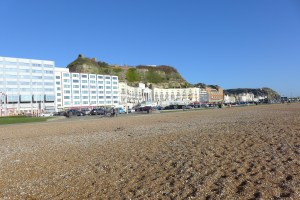
I’ve enjoyed an arm’s length relationship with Hastings for 30 years. Having a soft spot for English seaside towns since my childhood Kim and I often came here in the eighties when Epic Records provided me with a company car and an expense account for the petrol. We’d park in the Old Town and walk past the fishing net drying huts and up to West Hill. From there we’d look out across the lambent Channel and west to St.Leonards-On-Sea, beyond Bexhill to Beachy Head. I can still smell the seaweedy aroma of fishing, and old chip fat from the takeaways that line the promenade.  There was something about Hastings then that was both down-at-heel and appealing. Kim and I even toyed briefly with the idea of buying our first home here.

Since then Hastings, and St.Leonards-On-Sea to which it is joined at the hip, have drifted in and out of my life. Bassist with the Sade band Paul Spencer Denman, who I worked with for some years, moved here maybe 20 years ago, followed by other London media luminaries including former Elle editor Sally Brampton who gave me the first of many motoring columns. A couple of years back the friend of a friend upped sticks from London and moved in at the same time as I started listening to a jazz singer called Liane Carroll who grew up and lives in, you guessed it, Hastings.

Its position, 90 minutes or so from London by train or car, meant it has enjoyed the sort of short break lifestyle notoriety enjoyed by Whitstable and Southwold. Cool places for city dwellers to spend a weekend and feel affluent. There’s a name for them – DFLs (Down From Londoners).

With Russian and Chinese investors, and an expanding army of private landlords, pushing up property prices in London adventurous Millennial entrepreneurs and grown-ups trading down have moved in. The property sections of most newspapers proclaiming Hastings to be the latest hotspot. And compared to London it is very cheap. A two bedroom flat with an outer London postcode buys four bedrooms and views. The reason my morning coffee cafe was full of twenty-somethings with expensive haircuts on MacBooks and septuagenarians on iPads.

When another two friends cashed in their north London chips and bought into the Old Town I thought it was time Kim and I should go and see what all the fuss is about and how much or how little Hastings has changed in a generation – and a bit more?

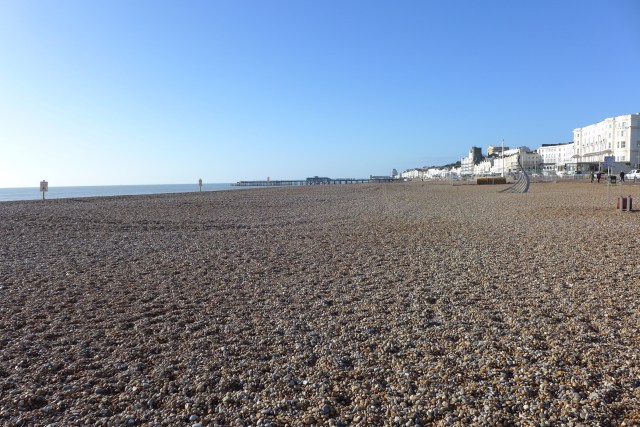
The beach is shingle. It makes a pleasant sound when you walk across it but it’s not so easy on dog’s paws. And with Asta acclimatised to the soft Cornish sand we decided to leave her behind, in the capable hands of Claire, who according to frequent email updates, ‘hangs out’ with Asta for two hour stretches on Harbour Cove. Clearly we weren’t missed. As it turned out one of the first things we learnt about Hastings is that  dogs are unwelcome, almost everywhere. Not a single stretch of the beach between the Fishing Museum and the new pier permit them. And there aren’t many places beyond that either, the man with a black Lab said. Asta would have to have trotted up and down the promenade, on her lead, avoiding the cyclists who have the priority.

Despite all the press don’t imagine for a second the town is gentrified. It’s far too authentic for that. At once charming and quirky and idiosyncratic it’s shabby, unloved, derelict and in need of paint. But thats its charm. Hastings has that seductive Notting Hill and Deptford feel of the 1970s, when art students, musicians and anyone with a slightly Bohemian inclination rubbed shoulders with gor blimeys. In other words there two distinct Hastings: The gentrified BoHo of the Old Town, with its vegan burgers, waistcoats and stout boots, and 100 yards away, beyond the Wellington Place pedestrian underpass, familiar  down market high street brands,  chubby folks with green hair, and wobbly boozers swigging from cans of premium lager.

There is history here in spades. From the Norman invasion a 1000 years ago to its heyday as a fishing port in the 19th century. The tall stucco Victorian houses that line the unloved promenade stretch inland for half a mile speak of more affluent times. Many are multi occupancy now.

I can understand why our friends have moved into the Old Town. It’s like Padstow, but bigger, with much more going on. Black and white Tudor homes with leaded lights stand cheek-by-jowl with red brick houses with mullion windows and Gothic doors. The big difference is people actually live here, and in numbers. You can tell the lived ones from the holiday homes because many of the lived ones have displays of shells and pebbles, bits of driftwood, models and photographs in the windows. I saw one with a Lego somethingorother and another with dinosaurs. Badges of local quirkiness.

There’s a thriving live music scene, a cinema club and theatre. And there are festivals. Highlights are a Fat Tuesday (that’s Pancake Day to you and me), and a motorcycle festival, and the four day Jack In The Green twiddly diddly Morris Men rites of spring piss up around May Day.

So a strong sense of community and a we’re all in this together attitude. An article on the gethastings website, headlined Why Hastings Is Not Shoreditch On Sea’ sums it up with – ‘if you’re going to live here, you’ll need to love its quirks and you’re going to need at least one fancy dress costume.’

Boulevard Books and other one-off owner occupier shops and cafes are focused along two principal streets,  George Street and High Street. Among them: Judges Bakery with bread for every conceivable food allergy; Made In Hastings, something of a pioneer opening in 2004 and on a mission to sell ‘quirky’ art and artefacts produced locally; Seagate, one of those old style hairy and chunky and leathery mens and womens designer outfitters that wouldn’t look out of place in Hoxton; more than a nod to rockabilly and early Elvis at Voodoo Sirens; something of 19th century seafarers garb at Warp & Weft; the restaurant, cookery school and interiors shop (they even have brush of the week) at A.G.Hendy & Co in a picture book Tudor house; and more antique and bric-a-brac shops than you throw a sow-ester at.

AGCool shops and bookshops masquerading as restaurants aside by

the end of my second evening it was clear the real reason my friend has moved here are the pubs. Real, no nonsense, old fashioned boozers, where everyone knows everyone else and most of the ale is brewed locally. Dozens of them. So many it was all I could manage to squeeze in five over two nights:

My favourite is Filo, although not named after some fancy sort of French pastry.  Filo is an acronym for First In Last Out. It’s got booths and an open fire with  beaten copper hood in the middle of the bar. I liked the look of the dapper gent in a fedora and blue waistcoat with the entire left side of his face tattooed. I chatted with a big man about gout (something close to my foot) and  drank Old Town Tom and got talking with a young couple with two puppy huskies; I liked The Cinq Ports Arms too. Pronounced ‘sink’ not ‘cinq’, perhaps a sign that Hastings voted for Brexit. It’s a snug bar with Ercol chairs and leaded lights and a chatty bar maid. The building is 17th century. No meals, just alcohol, pickled eggs and quiz nights; I took a shine to The Hastings Inn too, close to the front.  It was curry night when I seated myself on a bar stool and polished off a couple of pints of Goldings. There’s blues on Mondays and an ‘open mic’ night each Wednesday;  More music at The Stag, one of the oldest pubs in town. When I went the low ceilinged bar was crammed with mostly middle aged men playing fiddly diddly folk music, a couple of whom grimaced at my tie. Nevertheless the barman didn’t raise an eyebrow when I tried to cause a scene and complained my pint was flat; The Crown, near my friend’s, is a gastro pub that was touted as the best food pub in the country last year. The night I was there they were wine tasting in the back room.

It’s not all ‘quirky’ do-dahs and decent pubs. The Jerwood Gallery, hemmed in by fishing boats and the Fishermans Museum is a champion of British art. Central to its permanent collection are works by Hepworth, Lowry, Nicholson and Sickert. It’s a stark, bleak, modernist structure, encased in 8000 black tiles probably intended to harmonise with the sea washed pebbles and drying sheds. It’s won a raft of architectural prizes but non as prestigious as the RIBA Sterling Prize 2017 awarded to the remodelled and rebuilt Hastings Pier, half a mile to the west, closed due to irreparable storm damage in 2008. Its replacement, splashed across the UK media last year, is not like any other. Devoid of Edwardian fun palaces, finials,  guilded architraves and seaside tackiness, the flat, almost featureless new pier is proof that less really is more. The result is a wide timbered platform poking out into the Channel. A space, and a big one at that, designed to be flexible and lend itself to a multitude of purposes. Sea Life Crafts: Rainbow Fish and Sea Settler Workshop and weekly Yoga On The Pier. Get the picture?

The pier is actually closer to St.Leonards-On-Sea than it is Hastings, where a coastarati are concentrated around Norman Road, where lifestyle emporiums like Shop and Fleet Gallery stand alongside the Hollywood glamour of Siren. The latter turned out to be owned and run by Kim Denman, the beautifully baroque ’n roll missus of the aformentioned Paul Spencer Denman.

So there you have it. Hastings, a seaside town that’s happening in parts and not in others. A town where its easier to find a pair of ostrich skin cowboy boots than it is The Guardian newspaper: “That’ll be special order only,” I was told with no small amount of suspicion.

It has changed a lot in 30 years. For a start there’s a funiculaire from the fishing port up West Hill that wasn’t working when Kim and I used to visit. The Jerwood is a fine gallery and there are scores of the sorts of shops I’ve spent my life’s wages in. I think its fair to say that Hastings (and St.Leonards-On-Sea) have character, and a lot of very good pubs.

In case you’re wondering I rounded off my Thai dinner with a Rita Hayworth biography. I’m glad we weren’t in the DIY section.

Posted in Seashores, travel, Uncategorized | Leave a comment

Vandals at work – the death of the bungalow

There soon won’t be any 1930s bungalows left. While conservation groups, local authorities and investors, watched closely by the likes of English Heritage, take pains to preserve ancient cottages as well as properties from the Victorian and Georgian eras anything built between the First and Second World Wars, notably during the thirties, will either be demolished or refashioned in such a way as to be rendered completely unrecognisable.

This appealing yet ridiculed moderist architectural era, cleansed of the pompous garnitures of the Victorian period and inspired by the geometric simplicity of art deco (the affecting designs of Frank Lloyd Wright and notably William Morris’ Red House in Kent) 1930s houses and bungalows will soon be forgotten. Those garden suburbs of bay windows, sunrise garden gates and oak  front doors with inset bottom-of-the-bottle windows, red bricks, diamond shaped leaded window panes, gable ends, and garages with verdant drives, will be consigned to the historical dustbin. Their replacements bland anonymous structures created by expediency.Where once there had been well proportioned rooms with tiled fireplaces and parquet flooring there are now ‘living spaces’. It’s as though the gods of evolution have decreed that we should look at the dishes in the kitchen zone while we watch tv in the relaxation zone. The millenial take on refurbishment is all about space, unadorned floor to ceiling windows, and white walls.

In some ways the 1930s bungalow, a relation of the Californian Hollywood home, often with metal ribbon windows and curved ‘pantile’ tiled roofs, is a victim of its own success. Single story and built upon on large plots of land by proud home builders they lend themselves to property vandalism. Off comes the roof, often low hung in that appealing mansard style, to be replaced by a taller ‘A’ frame structure thus creating a first floor and more rooms. An increased value but at what cost? Diminished style and in many cases rendered unaffordable for the retirees and cultist 30s adherents who traditionally lived in them. 

The majority of 1930s bungalows have been bought not by people who enjoy their design cues and provenance but by bourgeois philistines who want to enjoy something else.

The architectural website Bricks and Brass states: “…this is a tragedy because in one aspect they have not been ‘neglected’; they have been the target of several decades of do-it-yourselfers who have ‘improved’ them to suit the demands of life…without preserving their character.”

This destruction is happening everywhere but non more so that in my patch of Cornwall. As each elderly owner moves on (single story buildings have an obvious appeal to the elderly) new money moves in accompanied by architects behind expensive Nordic spectacles muttering the same nauseous mantra – “more light, more entertaining space and low maintenance garden.” Encouraged by columns in national newspapers and online builder’s websites these genuinely modernest bungalows, often within classic English gardens, are remodelled into structures reminiscent of airport departure lounges with interiors boasting as much personality as a squash court.

Some four million homes were built in the 1930s, most of them in the suburbs or by the sea. I grew up in a 1920s semi-detached house wearing many of the design cues that would mark out those built a decade later. On a recent visit most of the Tudorbethan (mock Tudor) style houses in that estate now have plastic windows and clumsy boxy roof extensions. And where there were once gardens there are now, by and large, low maintenance concrete or brick car parks stained with sump oil. This is especially galling as nearly all 1920s and 1930s developments had access to garages to the rear via communal alleyways. The idea being that nothing  so vulgar and utilitarian as a car should be permitted to undermine the synchronicity of good urban design.

I had hoped to buy a 1930s bungalow some years ago. It was painted in that soft eau de nil, with a red pantile roof, nestling in its garden with the period elegance of something from Beverly Hills. In fact I think Jack Nicholson may have stepped inside one just like it in Chinatown. The only fault with it was a cheap plastic door porch. With that removed and some tlc it could, in my hands, easily have been upgraded to a pristine example of art deco coastal architecture. Sadly I couldn’t sell and so couldn’t buy and today that bungalow is unrecognisable. Like many others of that era it has sprouted extensions and windows and in so doing become another casualty of the war against the first truly modernist movement in British architecture.

As each 1930s bungalow is sold it is transmogrified into a bland domestic living/rental unit existing in a sort of architectural vacuum. I have black and white photographs taken 30 years ago of the estate near me. Each bungalow with a garden at the front. Most still retaining their original metal windows and bays. Each has a chimney and not one has a car on the front garden. Bungalows to be proud of? Only if you happen to live in Richmond-Upon-Thames. There the Conservation Area – Rosecroft Gardens no.46 (https://www.richmond.gov.uk/media/4077/ca46_rosecroft_gdns_lr.pdf), a triangular shaped estate of semi detached and detached 1930s bungalows, is enjoying a level of protection absent elsewhere. Among a raft of intentions that include a ban on front facing dormer windows and an insistence that metal windows be replaced like-for-like are the sentences – ‘…preservation, enhancement and reinstatement of special architectural quality and unity. Retain original detailing or ensure that replacements are of sympathetic design and materials…”

I have a hunch Richmond-Upon-Thames’ appreciation of 1930s garden suburb bungalows is out of step with the pervading ethos of originality bad, pumped up blandness good. In this way  a small but integral part of our British cultural heritage is vanishing.

Dilapidated and insanitary cottages have been saved in their thousands. As have endless rows of unloved Victorian terraces. The red bricks painted in pastel shades and fireplaces and ceiling mouldings reinstated. Just maybe, as a generation of young house buyers is driven ever further from city centres into the still reviled 1930s suburbs some of those currently overlooked art deco gems will be ‘discovered’. I hope so. If not we’re in danger of erasing an an entire era from the architectural history books.

Posted in gone west, London, Uncategorized | Leave a comment

Last Orders At The End Of The World

There’s nothing quite like the imminent end of the world to focus one’s thoughts on food. Long before Kim Jong-un and Donald Trump the father of a school friend of mine set aside a bedroom in the large detached family home in west London to store the bare necessities – should all hell break loose. Within a five foot tall pile beneath a white sheet in the centre of the room were sealed crates of baked beans and tomatoes, jars of pickles, biscuits, enough tea and coffee for an army, dried eggs, bundles of spaghetti and enough lavatory paper to maintain family hygiene standards for some time. Why John Tallent chose to stash these items away we never knew, although as a source of late night snacks the bedroom pile couldn’t be beat.  This being the early seventies it was, by current MAD (mutual assured destruction) standards, a reasonably stable world. Vietnam was a long way off and nobody was talking nuclear. Certainly the of threat of armageddon had dissipated since the nervy days of October 1962 and the Cuban missile crisis. Then the world held its breath following the discovery of Soviet warheads 90 miles from the Florida mainland. “We didn’t know if having gone to bed we’d wake up in the morning, that’s how close it got,” said my mother, who resisted the urge to fill her cupboards with  Cote D’Or praline chocolate elephants and Vesta curries. No, I suspect Tallent Snr’s bedroom stash had more to do with what he perceived as an end of life as we knew it due to the seemingly unstoppable influence of the British union movement. After all there had been the three day week, mining and refuse collection strikes, and frequent electricity blackouts. As a result the nation had been gripped with the notion of self sufficiency; shelves of survival books and novels like Doris Lessings Memoirs of a Survivor, and the television series The Good Life, set in Surbiton, in which Richard Briers and the sublime Felicity Kendall upset their posh neighbours by keeping pigs and growing their own veg; in contemporary parlance – doing their own thing.

The truth of the matter is food, more than millions of dead people and no means to recharge our phones or cars will be the priorities if things turn bad between the North Koreans and our special relations in Washington. According to experts each of us is nine meals from anarchy. This the number of meals that could be cobbled together with bits in the backs of our cupboards combined with anything we can loot from the local supermarket.

Opinions differ on how long any of us could survive without food. Mahatma Gandi, already a waif, went 21 days without sustenance. The IRA hunger strikers hung out for much longer. But what would sustain you if there was no end in sight for starvation. No food production and distribution, not forgetting a nuclear ‘winter’? The issue  was examined by Cormac McCarthy in his 2006 book The Road. A film version starring Viggo Mortensen came out two years later that I’ve never seen not wishing to be reminded of what could be one of the most unspeakable consequences of global starvation and anarchy.

Barely a day goes by without some wag hereabouts remarking that there may not be any point concerning ourselves with the effects of Brexit or the fall in the value of the pound or the lack of affordable housing. The War of the Stupid Haircuts looms ever larger: Kim Jong-un firing missiles over Japan and detonating nuclear bombs underground and Trump warning of ‘fire and fury like the world has never seen’. “There may not be a next year to worry about,” is phrase resonating in the pubs around here.

All of which leaves me in the local supermarket adding non perishable groceries for dinners at the end of the world. I already have one shelf of a kitchen cupboard nearly full. In case you’re wondering there are lots of tinned new potatoes, flageolet beans, mushy peas, sweetcorn and Ancona hot sauce. You’ll just need to provide your own loo paper.


Posted in health, shopping | 2 Comments

A good day for Tilly

Tilly – all at sea

Little Tilly will never know how close she came to never enjoying another beach walk. Today, September 4, 2017, was to have been the Staffordshire Bull Terrier’s last. No more runs on Harbour Cove with Asta, her jaws clenched ever so tightly around the ball her Airedale friend would give her eyeteeth to get hold of. Waking this morning to the sound of gulls Tilly had been unaware that she had awoken from what by rights ought to have been her last night last curled up on the bed next to Jane, the woman who has cared for her, fed her and walked her, and carried up the stairs to her apartment, and more recently taken her to the veterinary surgeon to learn the worst, the sum of which the little terrier will never know.  And to be frank, it didn’t look good. The tumours that tyrannise her seven year old body – first appearing on her skin thence spreading to muscles, organs and bones –  and that have made her sick, and yelp in pain at the lightest, and tenderest touch, were such that today was to have been the final adios. Jane had duly notified everyone with a care for Tilly and all shed  tears at her prognosis: Ollie, Jane’s son, with whom Tilly had lived until a change in his domestic circumstances; Juan Carlos the lodger who hadn’t known Tilly that long but like all who came into contact with her was overcome with her loyalty and joi de vivre; and finally Mark, the Californian writer next door who watching how many of us derive pleasure from caring for our animals, and seeing how that affection is reciprocated, remarked that should he have the chance to come back in another life, “I want to come back as Asta.” Mark, like the others wept this morning in the full knowledge that as Tilly stepped into the back of Jane’s Nissan it would be for the last time. Placing the fate of a pet in the hands of a veterinary surgeon whose only hope is to make the imminent passing as swift and painless as possible isn’t easy. I’ve been there three times and all I can say with any authority is that it gets worse each time. Each pup wears an expression that  asks, what is happening? They know the routine they love and adhere to has changed but cannot comprehend how or why? They don’t know why hills are steeper and cars are higher, their little legs are stiffer, and food no longer tastes as good. Everything they depend upon and trust is you. Confident that in the last resort there is nothing you would do to harm them is what sustains them. Until. Well, happily for Tilly fate had other plans.

“Like Lazurus she’s risen from the dead,” exclaimed Jane, almost unable to comprehend the turn around in Tilly’s fortunes, who was, by all accounts, back to her old self at the surgery. Her cancer is as invasive and relentless as before, but as if sensing something irreversible Tilly put on such a show of good health that all plans for a merciful end were  shelved. She’s not exactly better, but she’s rallied enough to swap tears for apprehensive smiles. Steroids and other drugs prescribed Tilly was sent packing with nought more severe than advice to keep an eye on her.

Way to go Tilly. Harbour Cove awaits.

Posted in Dogs, gone west, Seashores, Uncategorized | 1 Comment

Hello, I’m Seamus – give me your money


4221396001_5056610000001_5056548208001-vs

I’m not unique. We’ve all been there. The phone rings and a voice introduces themself as Andy, or John: One insisted to me his name was Seamus without so much of a hint of an Irish accent; although perhaps with a dash of irony.

What follows is a technically convoluted speech in which Seamus (lets give him the benefit of the doubt) tells me there is something seriously wrong with my computer. He warns that all kinds of people could be accessing my hard drive as we speak, helping themselves to my personal details. Fortunately Seamus, all the way over there in the back of beyond, can fix the problem. I just need to give him direct access to my computer and all will be fine.

Yeah. Does Sean think we were all born yesterday? Well, maybe he does because ‘spoofing’ or ‘vishing’, as it is variously known in the online fraud trade, is on the rise. As an industry in the UK last year it was worth £755 million, representing an increase of 26% over the year before. That’s roughly the turnover at Harrods and slightly more than Selfridges. And that’s the stuff they get away with. Prevented online fraud during the same period was £1.76 billion. Yes billion.

My friends joke how they swear down the phone at Seamus and his associates. Whereas I, not wishing to encourage any online backlash, tend more to the polite thank you and goodbye. Except for one occasion earlier in the year when I told him to ‘fuck off’. It didn’t work. He called me back a few moments later and told me to “ fuck off”. I called him a name I normally reserve for my closest  friends and right wing politicians whereupon he rang back and called me the same name, adding that various members of my family are whores, and so on. I left the phone off the hook for a couple of hours to be sure he wouldn’t call again.

Nothing quite that surreal has happened recently. I still receive unwanted calls, in addition to the endless PPI and ambulance chasing insurance scams. But most of my contact. with this underworld, this dark web of crime are via emails, or ‘phishing’ as it is known. These are the emails that to all intent and purpose have originated from a reputable organisation, one that I may have regular contact with either via email or telephone. Those purported contacts that make us feel wanted and important. That make us feel a part of this interconnected digital world.

Indeed, as I write a fake LinkedIn email has dropped in telling me of a message awaiting me; just click. And another from an imaginary Chloe Matthews at Gmail.  In this world of instant digital communication the criminals know few of us can resist the invitation to log on – to connect. This is the post-thinking age afterall.

In the old days of high streets, half crowns and honest bankers my only infrequent contact with villains was pickpockets in the west end and Gard du Nord.  Nowadays, thanks to the internet, modern con-tricks  are unfolding in my living room. Confidence tricksters used to look like Terry Thomas, with pencil moustaches and oily hair and an eye for the ladies. Today’s come dressed as bank managers, courier companies, and social media platforms.

It’s not new. A couple I know, banking with Barclays, had £15,000 or thereabouts taken from their savings accounts after responding to an email that looked like it had originated from their bank. It stated that their account had been compromised and they needed to renew their security details.

They got their money back because in the early days of online fraud, before the sums involved became so eye wateringly huge, banks were sympathetic. That’s all changed. Nowadays banks are much more likely to blame the fraud on our  negligence. Of course it’s nothing to do with the fact that banks are closing local branches faster than you can come with your umpteenth password, and forcing us to bank online or by phone whether we like it or not. Banking by smart phone anyone? According to the most recent statistics 2000 smart phones are stolen each day in the UK.

According to Financial Fraud Action UK 75% of all financial fraud is card payment. Fraudsters use stolen card information to go on shopping sprees. The next most popular is remote banking, accounting for 22%. That’s when we click on the fraudulent hyperlink on a phishing email that dispatches a ‘cookie’  (such a friendly name for such an insidious invention) to the heart of our secrets and allows criminals to help themselves to our money.

The third most type of fraud is cheques, accounting for, wait for it, 3%. Cheques being the payment method the banks want to discontinue, along with branches and real people on telephones.

Every day is struggle against the forces of darkness. This week alone (November 2016) I have received daily emails from two banks (Barclays and Santander) and something that looks it may have come from FedEx, advising me of a parcel awaiting delivery with the obligatory hyperlink to hell. In the age of internet shopping who isn’t expecting a package? The man at FedEx couldn’t mask his boredom when I inquired if the emails were genuine. “No,” was all he said.

Some of the emails are easy to detect. Like on of those from a Barclays clone that said, and I paraphrase, that if I didn’t clink the link provided and enter my security details, “it would be very bad.”

Perhaps the scariest email out of maybe 200 or so this year arrived at the beginning of the week purporting to come from a dear friend. It was a link to a website or article she thought that I would be interested in. And yet there was something in the language. It didn’t ring true. I put the email to one side and got to speak with my friend some hours later. She confirmed that it wasn’t from her and confirmed also that another friend had received one similar. She speculated that a recent hack in the Yahoo site, with whom she had an account, could be behind it. When I put her on hold to look at the email again and give the exact wording it vanished right before my eyes. Spooky? Tell me about it.

I don’t know about you but it’s got to the point where I won’t open any email until I am convinced it is genuine. Life has become an unwanted daily struggle against an army of well trained and highly motivated criminals – all probably on minimum wage, wherever they are? I take a screen shots and delete all the originals and just to make sure I empty the trash. According to a particularly patronising voice at my bank I am right to be sceptical. But why do we have to be on our toes in our own homes? It’s modern life you say. Well, it’s not the one I want to be a part of. Admittedly there’s not a lot we can do individually, except perhaps stop online shopping and banking. Think about it. High streets would come back to life. Delivery drivers and warehouse employees working on or below the minimum wage could get decent shop jobs. The last time I looked 135,000 bookshops have closed in the US as a direct result of Amazon. By 2014 the number of independent bookshops here in the has fallen by over a third, to below 1000 nationwide in ten years. It’s one of the reasons I stopped using Amazon seven years ago.

So – we get to keep our money. Stop the crime, and save our high streets. Not a bad way to start 2017.

Posted in shopping, Uncategorized | 1 Comment

Asta and Judgement Day

Asta turns the other cheek while Kim resist the urge to throw a punch

Asta turns the other cheek while Kim resists the urge to throw a punch

It’s generally inadvisable to loose temper with a man of the cloth. The ramifications could go on for, well, a very long time. Of course I knew of the local vicar, the one who oversees much of community life around these parts with his easy-going, witty and frankly disarming demeanor, was only trying to be supportive; aiming to ameliorate some of the inevitable tension. But by stopping directly behind Asta and I at the very moment the judge at the Trevone Fun Dog Show was assessing my girl’s eyes for the prestigious Prettiest Eyes section, I’ll admit  – I very nearly lost it.

The night had not begun well.  Kim and Asta got off to an abysmal start in the Best Pedigree section. There were so many entrants the judge sensibly elected to whittle them down to a final elite with Asta, and many other handsome specimens, ejected in the first round. Kim’s expression said it all. Kim doesn’t take failure lightly, making accusations of a fix on the basis that the judge, a professional dog groomer was inevitably going to choose those dogs he’d worked on. Inspecting Asta the judge had apparently said Airedale Terriers were often aggressive. I thought Kim was going to throw a punch.  According to her the man next to her in the ring had said that he and the others were wasting their time as Asta was evidently a shoe-in. An opinion echoed by the ruddy faced woman on the plants stall who said Asta not winning was clearly a miscarriage of justice.

The event was being held in the grounds of Well Parc, a family run hotel in one of the finest locations on the north coast. It faces due west with uninterrupted sunset views of the Atlantic with verdant cliffs spanning north and south to Padstow and Newquay. There are rumours that a certain celebrity chef wants to buy it and transform it into the jewel in what is already a pretty impressive catering crown. Which would be a shame as this part of Cornwall could do with a few more old fashioned, affordable, un-west London, un-groovified places for those who are happy enough with a pint and a packet of cheese and onion. Looking around at some of the tall, pelate thin, blonde holidaying mums with a lots of spelt bread inside them, their glossy cockapoos at the heels, anyone could see a change is coming.

We were there because our friend Jane, novelist, aesthete, and motivator behind our Thursday night film club, was the dog show’s chief organiser. She’d pretty much insisted that Asta should enter, all the monies (£2 a category) going to local church charities. Fearing the worst ( Kim still smarting from Tashi Delek crashing out of a dog show in Camden some years earlier) we nevertheless decided to give it a go. In preparation Kim had stood Asta atop the kitchen table for much of the morning preening and grooming. However, after that humiliating first round there was talk of abandoning the event altogether and going to the pub.

Of course it would have been churlish to to pull out so early on so we (ie Kim) decided that I should step into the ring with Asta for the Prettiest Eyes contest. Downing a large gin and water I began to remove my cravat fearing I might be overdressed for such a fleecy, shorts and Crocs event and thereby risk prejudicing the judge against Asta for a second time. Kim insisted the cravat remain.

Competition was again very stiff. There were a great many entrants, maybe twenty. After all who doesn’t think their dog’s eyes are the prettiest? Indeed dog’s eyes are often thought to be the most endearing pooch feature of all. Ok, tails are popular too, and can tell a good deal about a dog’s character and temperament. Asta does in fact possess a very fine tail. Rare among Airedale Terriers to be un-docked, long, curly and bushy with Pre-Raphaelite curls. The snag was that it doesn’t wag preternaturally, or of its own accord. She has a fine wagging tail when she chooses to wag it, but it doesn’t sashay back and forth 24/7 the way others attached to – I don’t mind saying it – less sophisticated dogs. Certain things set her’s off. One of them, said Kim, is me; my arrival at any situation. With this in mind the pair of us hatched a plan in which I would conceal myself behind the beer tent. Then upon Kim giving the Asta whistle (this is the tune of Pluto Shervington’s ‘Dat’ that some readers may know was a reggae hit in the 1970s) I would burst on to the scene and Asta  would react by wagging furiously. However, the sheer number of people and dogs meant we couldn’t guarantee Asta would see me in time. The plan was too risky.

It had to be the “Prettiest Eyes’, with the cravat.

The ring filled up with a range of breeds. An American Eskimo, Collies old and new, a Dachshund (bearing a rosette from an earlier round), a Spitz, Schnauzer, a Pomeranian, a young white Whippet, a lovely old brown Labrador next to us and a mixed assortment of also rans. Most were pulling their owners hither and thither. Dogs sniffing each others’ behinds and owners trying to stop them. To counter the ‘aggressive’ charge I knelt down beside Asta. She responded perfectly by sitting down next to me. I wanted her looking straight ahead so that the judge could see directly into those soulful brown pools of canine innocence. The young girl with the chubby chocolate brown Lab next to us knelt down too.

“Oh look,”  she said looking into Asta’s eyes. “They are lovely.”

As the judge made his rounds, from our left to right, the silver haired vicar, speaking whimsical words of encouragement and support through across the Tannoy, moved around behind us. He stopped to say something about Asta the very second the adjudicator was attempting to look into her eyes. Asta span around to see what was going on behind her, eyeballing the vicar and pointing her arse at the judge. I tried, gently, to turn her the other way to no avail. The damage was done.

“You’re a hindrance,” I barked at the vicar, regretting it as soon as I’d said it. He smiled and moved on.  Asta turned back to face the judge who had also moved on. It was turning into a re-run of Camden; bearded youths with heavy metal t-shirts were winning bottles of Jack Daniels; dogs the size of pasties were winning bags of treats; and Asta was going home empty handed.

All that remained was for the judge, who I don’t think stopped smiling for the entire duration of the show, grabbed a handful of rosettes, in all colours, and gave one last look at all the ‘Prettiest Eyes’ entrants. Perhaps to reassure himself he’d made the right decision.

And the winner?

“You,” he said giving Asta a toothy grin and handing me the red rosette for first prize.

“Because she does have the prettiest eyes,” said the little girl to our left who didn’t seem to mind at all that the judge hadn’t given her lumbering chocolate Lab a second glance.

Kim was delighted. Jane, perhaps unsurprisingly for someone who’d recently leant me both Rupert Everett biographies, said the judge had been looking into my eyes and not Asta’s. And the woman at the plant stall was so delighted with the result she threw her arms around Kim.

Asta stuck her head so far inside the treats bag it stayed on as a hat. And I think the vicar forgave my outburst because as we turned to leave he smiled and said Asta was lovely.

the eyes have it

the eyes have it

Posted in Dogs, Uncategorized | 1 Comment