Kim at The Affordable Art Fair Hampstead

Those Londoners who haven’t been down to Cornwall to see Kim’s embroidery/paintings will have the opportunity to enjoy them in the flesh, later this week.

From Thursday to Sunday (November 1-4) a selection of her works will be on sale at Demelza’s Gallery, at the Affordable Art Fair Hampstead; held in a specially erected building on the car park, just across the way from The Freemason’s Arms, a three minute walk from Hampstead Heath London Overground Station.

Most pieces on sale are those beach scenes of sailors, and dog walkers, surfers and picnickers, milling about beneath billowy skies, on the Atlantic washed beaches on north Cornwall, close to our home in Padstow. However, there are others at the London show for which Kim has applied the same technique of painted silk taffeta and embroidery in locations that will be familiar to anyone who walks regularly upon Hampstead Heath. Here Kim’s keen eye for everyday detail, the hidden charm of people’s lives, uses Parliament Hill Fields and the London skyline as a backdrop.

Of course, there are dogs – there will always be plenty of happy dogs in Kim pictures – but there are sightseers too. Football players, couples, and my favourites, kite flyers. The more you look the more you see. Hope to see you too.

Kim Bentley, Demelza’s Gallery, Stand D2, The Affordable Art Fair, Hampstead Heath, Lower Fairground Site, East Heath Road, NW3 1TH. Tickets range from £10 to £20. There is a charity private view Wednesday (Oct 31) £25. Cheaper for concessions and if you can get a half price ticket from one of the galleries showing.

For a little more visit here http://kimbentley.me

Posted in London | Leave a comment

Summer at the Serpentine – Thursday nights with my mate Bob

I learnt a lot of things about London and Londoners on Thursday. For example I learn that Michael Caine made his screen debut in the 1961 film The Day The Earth Caught Fire, playing a London bobby ushering members of the public to safety, and that he developed his trademark ponderous and methodical style of speech in order to maximize the time he was on camera. 

I also learnt that the telephone box in Heddon Street, immortalised by David Bowie on the cover of Ziggy Stardust and the Spiders From Mars, appeared in Michelangelo Antonioni’s Blow Up, with David Hemmings; that the expression ‘falling off the wagon‘ came from condemned convicts being allowed a drink in a saloon on their way to the gallows, and that Chas Hodges, the curly haired one in Chas ‘n Dave, wears plastic Crocs shoes, and used to sing with an American accent with Jerry Lee Lewis. A veritable soiree of learning

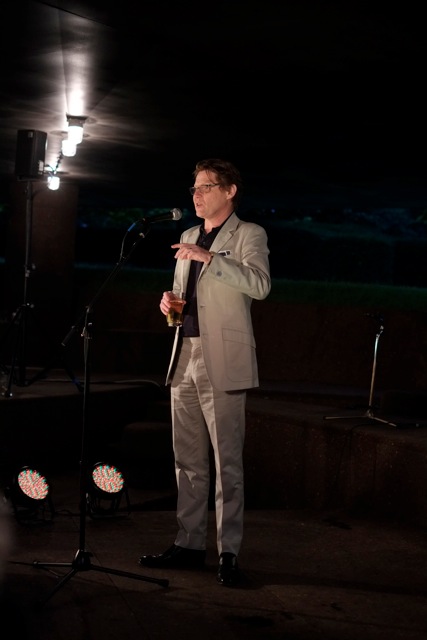
That and live music from the cinched and very delightful Segue Sisters (think Andrews Sisters crossed with Cabaret), some comedy, and even a few card tricks and illusions, and all for the princely sum of  £10. Actually I should declare here that Elms is a good friend of mine, meaning that Kim and I didn’t have to pay. But if we’d had to I couldn’t have complained at all at that – and a dry spell in the heart of London’s loveliest park – for the price of a round of drinks.

Cynics might here point to a clear conflict of interest, one that might have impaired my impartiality. Perish the thought. Thursday evening at the Serpentine, was in the words of Steve Marriott at the Fillmore, ‘a gas’, and never less.

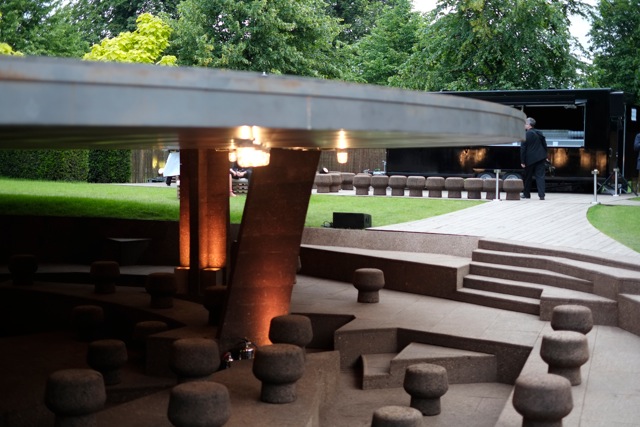
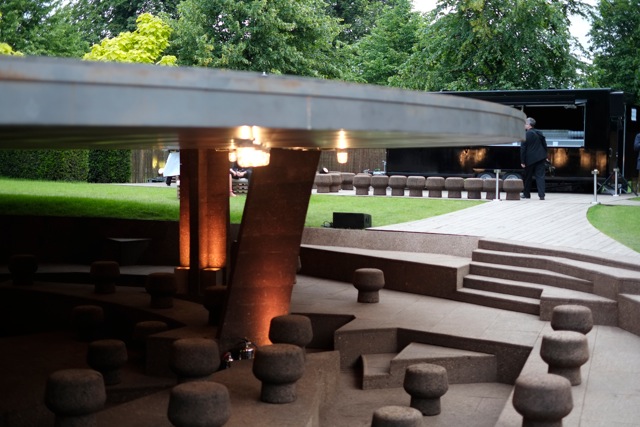
This was the second of his Thursday Nights Lives, informal and fascinating events held throughout the summer in Hyde Park’s Serpentine Gallery Pavilion, close to the lake,on the southern side of the park, a stone’s throw from the Albert Memorial. Every year, for the past twelve, a different architect has been commissioned to design and build a new summer pavilion on the site,  from scratch. The current one, resembles a flying saucer hovering just feet above a scoop in the earth and is furnished with benches and what look like giant mushrooms. It is the result of a collaboration between architects Herzog & de Meuron and Ai Weiwei. It’s rather lovely, works extremely well as an open sided summer pavilion, and will be taken down in the autumn.

The events are live versions of Elms’ popular radio show, broadcast six days a week on BBC London. It shares the same a blend of music, events, history, personalities, and the sort of information that goes down well at dinner parties. Except whereas on the radio Elms’ enthusiastic trademark interaction with his audience is channelled through modern digital media, at the Serpentine Gallery the audience is actively encouraged to take part. Questions like, ‘what’s your favourite London film’ was thrown out to the gallery? I offered Donald Pleasance in 1973‘s ‘Death Line’ – vintage British horror in which the crazed zombies that inhabit the tube system mumble “mind the gap”.

Elms show’s ‘rock ‘n roll route master’ Russell Clarke traced the history of live music in Hyde Park, from the first with Pink Floyd playing on two flatbed trucks, while the effusive and always good value, Jason Solomons ran through his top ten of London films. He left us with a thigh slapping excerpt of Dick Van Dyke’s coal stained Chim Chim Cheree from Mary Poppins. Von Majik, a young and softly spoken magician from south London made balloons and ten pound notes disappear, and comedian Barry from Watford was very, very funny, doing for the navy blazer what Berlusconi did for the bandana.

Finally, before a barn storming boogie woogie performance by Chas Hodges (Gertcha and Roll Over Beethoven) Senna director Asif Kapadia talked about Odyssey, a film commission by the BBC for the OIympics, and which was shot entirely from the air. It is being screen this coming Tuesday (July 24).

The first Thursday night featured Elms’ old friend Gary Kemp (you may recall among the host’s many claims to fame was naming Spandau Ballet). Others weeks promise Sir Paul Smith (they’ll probably discuss suits and cycling), Heaven 17, musical arranger and 007 aficionado David Arnold, novelist/journalist, and another Elms spar, Tony Parsons, radio regular Maxwell Hutchinson (architecture), and more from the Segue Sisters and the mightily funny Barry from Watford.

There’s nothing on the telly Thursdays, and it’s all kids films at the cinema this time of year. It’ll be the best tenner you’ve spent in a long while.

Thursday Night Live with Robert Elms, July 26, August 2, 9, 16, 23, and 30, from 7pm.

Tickets available from www.eventim.co.uk/0844 249 1000, or from the Serpentine Gallery Lobby Desk www.serpentinegallery.org

+ all photographs by Christina Wilson +

Posted in London | 1 Comment

A Very Special Dog

Tashi Delek, the most photographed Airedale Terrier in Cornwall, died peacefully on the settee, in the living room of her home in Padstow.Tashi, or Tash, or Snoo as she was known to Kim and myself was born in Grantham. She was the last of a litter of nine puppies to find a home, passed over repeatedly due to the straightness of her coat, that Kim and I were told, would not go down well with dog show judges. Kim and I looked at each other. As if!

On the long drive back to London, Tashi Delek, almost jet black and the size of a shoe, was ill several times on the back seat of the car. Long car journeys were to remain one of her bete noirs until the last, together with cats, squirrels, and postmen.

Tashi’s early years were spent in London’s Regents Park. She was the prettiest of a group of puppies ( among them Billy, Coleman and Carter), who met daily close to Gloucester Gate following the outer perimeter, as far as the tennis courts. It’s when Tashi developed something of a thing for tennis balls, especially new ones. If she couldn’t find one in the grass beyond the courts she’d sit and wait, refusing to budge, until the tennis coach, a thick set man with white hair, had whacked a fresh ball over the link fence, just for her.

Her collection often exceeded three dozen.

It was on these happy walks that Tashi made the first of many lifelong friends, Carter, a handsome chocolate brown Labrador. Carter took an instant shine to the leggy Airedale and would present Tashi with sticks or chewed up balls whenever they met. If Tashi grew tired of the gang, if ‘something in particular caught her attention’ causing her to leave the pack and wonder off, Carter would bark furiously until she fell back into line.

The pair maintained their friendship even after Carter’s owner became ill and was unable to cope with a young dog. He relocated to Kidderminster, taking up residency with Kim’s parents. Tashi and he enjoyed many happy times together there. They played together there just a month ago.

The “lovelies” grew out of those early walks. Such were Tashi’s looks – her jet black saddle, her deep brown eyes, her ‘envelope’ ears and light trot, that bystanders’ were caused to remark “isn’t she lovely”. In fact, it was said so often Kim would  return home daily with The Lovely Count: Tashi’s highest for a single walk was twelve, although that doesn’t include those admiring ‘lovelies’ thought  from a distance.

One of Tashi’s many endearing qualities, aside from her unbridled glee at unwrapping everyone’s gifts on Christmas Day no matter how elaborately wrapped, opening the Bonio cupboard door in the kitchen herself (showboating to impress guests), and never returning home without a ball or toy of some sort, was her gentleness, and willingness to turn the other cheek.

Whenever confronted in a street by the salivating fangs of the hounds from hell Tashi would come to a stop and look the other way, to a point somewhere in the distance, as if she hadn’t seen the predatory hound because she was preoccupied, like a bird watcher or meteorologist, on some faraway object. When this effective distracted indifference  (another example of the ‘something in particular’ trait) had taken the sting out of any potential attack, the other dog or dogs by now too confused to be violent, Tashi would quietly, and very beautifully – tale erect and head held high – silently saunter past, as if nothing had happened.

Tashi’s nature, her gentleness with children, her exuberance, especially on the soft sand at Harbour Cove and upon Hampstead Heath, and her looks soon spread beyond the close circle of family and friends; those who broke their home rules, allowing her to sleep on the furniture and chase their cats into neighbours’ gardens. She lent her name to a series of compilation compact discs, Tashi Toons, culminating with the Christmas collection Santa Paws. She was photographed on the pavement outside her Cornish home by countless numbers of holiday makers. She went on to feature in the book Travel, photographed by Christina Wilson,  The Daily Express’s travel pages, and appear on the cover of the Financial Times’ How To Spend It ‘Travel Unlimited’, in May 2008.

Latterly Tashi had become a fixture of many of Kim’s beach painting/embroidery images. Look around her assembled cast of seaside characters and you’re sure to alight upon a perky Airedale Terrier doing what she did best – having fun on the sand. It goes without saying that Kim’s pictures with Tashi in them have sold the fastest.

Despite the media attention Tashi kept a level head wanting nothing more for herself than any bed or settee in the house, and the three ‘Cs’: chocolate, chicken and cheese.

Her gentleness, her fondness for long hugs, and evenings curled up next to you on the settee meant that everyone who spent any time with Tashi fell for her. When our dear friend Pat, stricken with cancer, took to her bed on winter afternoons in Padstow, Tashi joined her. And when Kim and I were away Tashi would occasionally decamp temporarily to Muswell Hill, curling up beneath author Rob Ryan’s desk. “There isn’t a malicious bone in her body,” he remarked.

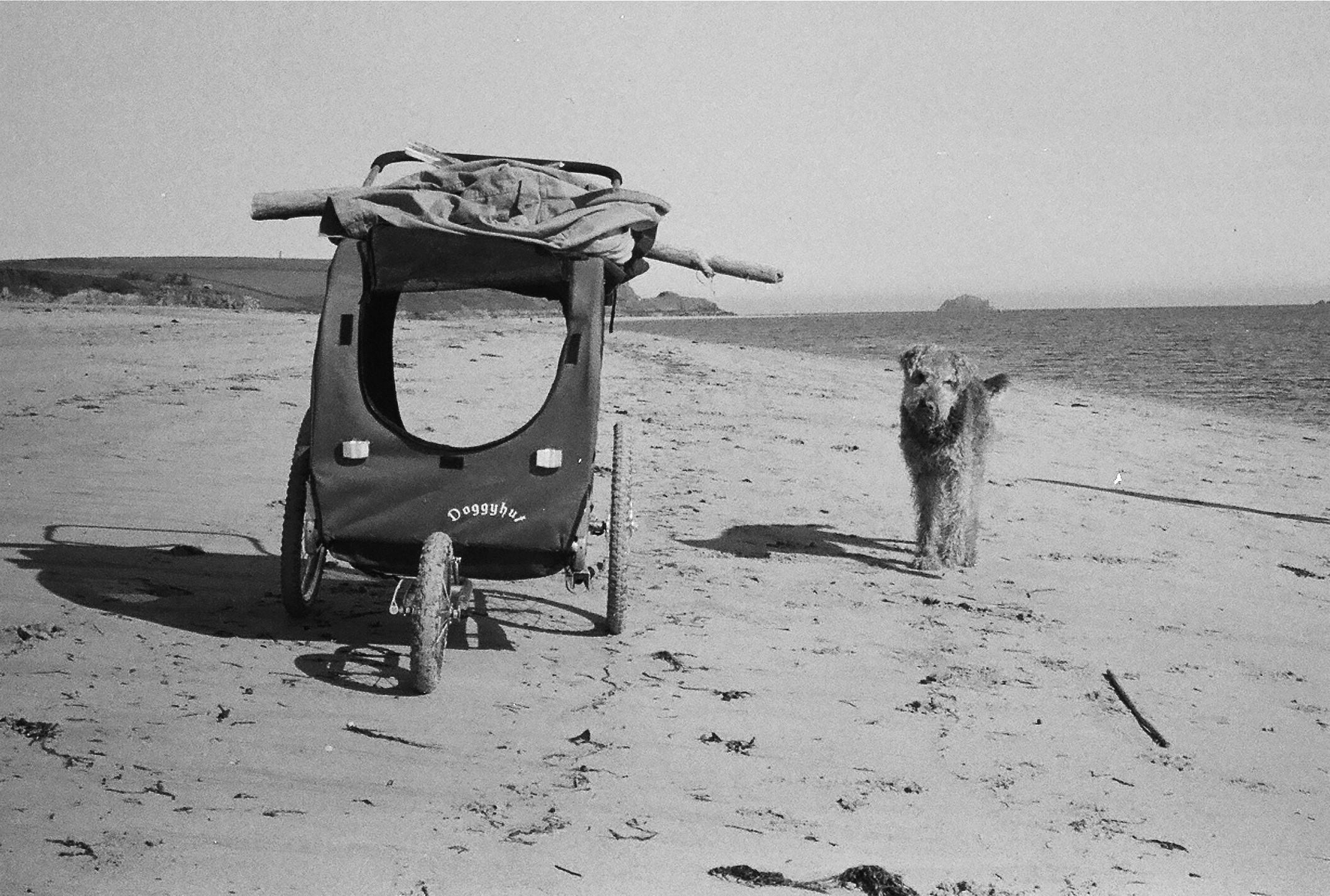
Some months before her death she was presented with a three wheel Dog Buggy. It raised a few eyebrows in Padstow, but arthritis had taken hold and the short walks to the beach to be with her friends Skye, Rosie, Daisy, Macie, Jo, Matilda, and Rio had become something of a marathon. Reluctant to get in at first, perhaps embarrassed to be perceived as an invalid, she nevertheless grew to appreciate the red canvas buggy, and would clamber in, even as it was being assembled.

Towards the end, when kidney disease had made her anaemic and weak, she’d lay in it outside the house watching the world go by, maybe wondering why life had become so difficult for her, but still enjoying the attention, and the ‘lovelies’.

Her last buggy trip was an hour or so before she died. The scent of wild garlic heavy on the warm spring air. Wispy pink clouds scudded across Bodmin Moor, leaving behind them deep pools of irradiant evening sun.  And the Camel estuary, motionless out of respect,  that indefinable colour between grey and blue.

Tashi saw it all, maybe thinking, after all the effort of the last few days, she was seeing it for the final time.

Tashi Delek, June 5, 2000 – June 26, 2012 

Posted in Dogs | 16 Comments

It’s Good To Talk

When I returned to my desk, after a couple of days in the west country attending the funeral of an old school friend, I booted up my laptop to find 252 emails awaiting me. The subjects therein ranged from outward bound footwear and luxury self-catering cottages in Sweden, to cutting edge mattresses made in the west country, and a children’s clothing range that, the press release assured me, is worn by both Gwyneth Paltrow and Madonna’s offspring.

Turning to the answering machine, aka voice mail, there were two calls from an ambulance chasing firm of solicitors who had called to say I was owed compensation for an accident I cannot remember having. Three others from people who left no messages, and one from myself trying to find Kim.  As for mail there was an issue of the New Yorker, two payments slips, and some vouchers for a supermarket.I mention this because it is illustrative of the way modern PR and marketing is conducted; at a distance, behind a veil of digital technology, that flatters to deceive. Most of my articles, either consumer based or travel, appear in a number of national publications, The Sunday Times, The Financial Times, both The Daily and Sunday Express, and many others over the years, and yet I cannot remember the last time a PR called me to suggest a story. I think it was in the spring of 2011, but I cannot be certain.

Such a statement could invite a tidal wave of cold calls, yet I suspect not. The current paradigm for product placing is a jaunty emailed press release, nine times out of ten beginning “Hi Jonathan, I hope you’re well?”, often followed by some light hearted  reference to the weather, or a contemporaneous sporting event.  Most will be discarded without ever opening.  Others require time, on average a minute, which means, about an hour a day reading unsolicited emails. Multiply that by five for my editors coping with a tsunami of correspondence.

There is a casualness about such emails. Spelling mistakes, factual mistakes and naff jokes aside, how important is the thing being promoted if the limit to the PR’s marketing skill is a computer database and a send button? That’s another ‘hope you’re well’ , a likable aside to the ‘footie’, and back to Facebook.

Responding to emails is rarely easy. If I telephone I am generally rerouted to a voicemail where I am told that the person is away from the office – until last week! Sometimes I get a receptionist asking more questions than the inland revenue who will go on to explain that the PR is in a meeting. So many meetings, probably about databases. The daughter of a friend told me how in their Soho marketing office they would hold all calls once a week for what the head of the company described as a ‘concept fuck fest’.

This reliance upon digital  communication overlooks the ease with which even the most complicated arrangements may be dealt with over the phone. It is not uncommon for there to be eight to ten emails for me and whoever it is to finalise details, or get the correct resolution for a photograph, when everything could be ticked off with a single call, a notebook and pen.

Prior to the advent of smart phones, the must have tool for all modern PRs, I would often do my correspondence in the evenings and weekends, replies coming back during he next working day. Not any more. The new PR, armed with iPhones and Blackberries, and anxious to please and impress friends and colleagues, is often quicker to reply at night than during the day, often at times when every PR worth his or her salt is holed up in a wine bar with a large glass of Sancerre.

Years past PRs would call me with suggestions for articles. The conversations relaxed, across a range of products and issues. Among the best practitioners of this patient one-to-one marketing were the legendary Rob Partridge at Island Records, Joanna Burns at Epic (lately with her own company), and Stephanie Briggs at Spring in the west country. Partridge, who passed away some years ago, was masterful. I was a music journalist and after half an hour on the phone with Rob,  I would have a wealth of material, with notes of up and coming events and releases. He knew who I wrote for and tailored items to suit, while subtly planning ahead, tipping me off to future developments.

Partidge’s easy going knowledge of the music business and Joanna Burns’ methodical system of breaking journalists down into lists and subjects and thereafter working the phones, patiently and politely, is how I learnt my craft as a PR in the 1980s; working with Wham! and then subsequently for much longer with Sade.

That generation of PR spoke.  It could be hard work, and monotonous at times, but it was good to talk – and had its rewards.

Posted in media | Leave a comment

Rock ‘n Soil

A long long time ago Crackington Haven, a vertiginous fold on north Cornwall’s north coast, south west of Bude, lay at the foot of a range of mountains. A lot has changed during the 350 million years (or thereabouts) since then; the mountains have gone, the Atlantic Ocean has excavated arches and ‘hanging valleys’, and there are coffee shops as well, including one with a range of excellent apricot flapjacks.

The extent of the telluric shifts that have shaped this tiny area, known as the ‘Crackington Formation’, renowned for its slate, zinc, and wolfram (the principle ore of tungsten), is brought home to me by geologist Jane Anderson, during a short walking tour. She is one of seven geologists employed by the North Cornwall District Council whose remit is to apply lessons learnt from ancient history to land management; her knowledge and experience helped design bridges in both Crackington and Boscastle following major floods.

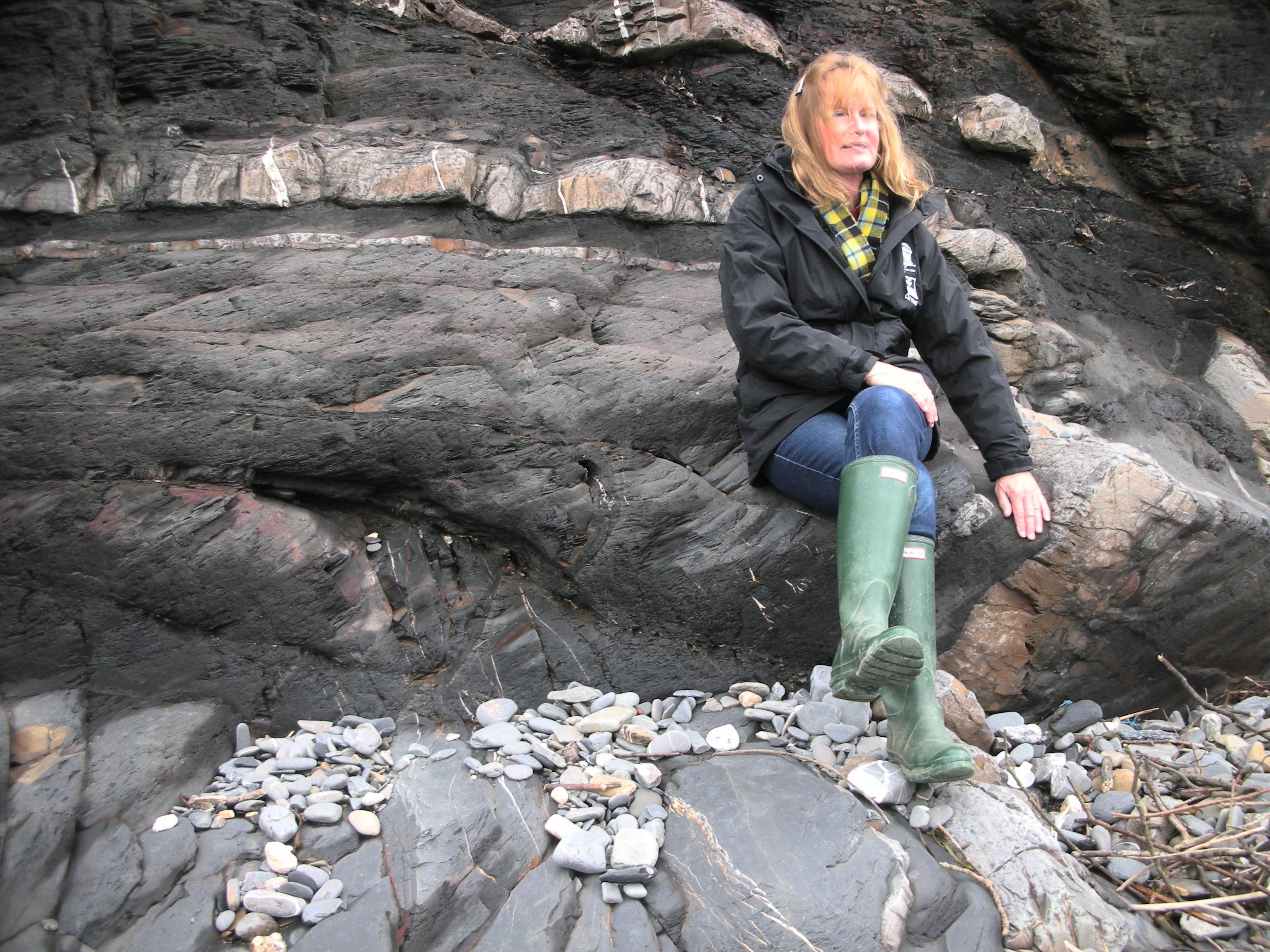
Jane has strawberry blonde hair, alert eyes, and an easy smile while she talks; think Julia Roberts in an anorak and wellies. A dozen or so of us would-be geologists meet her in the ‘Haven’ car park at coffee time; an assortment of cajoles, walking boots and poles. We follow Jane across the road to the pebbly beach at low tide where she begins her tour.

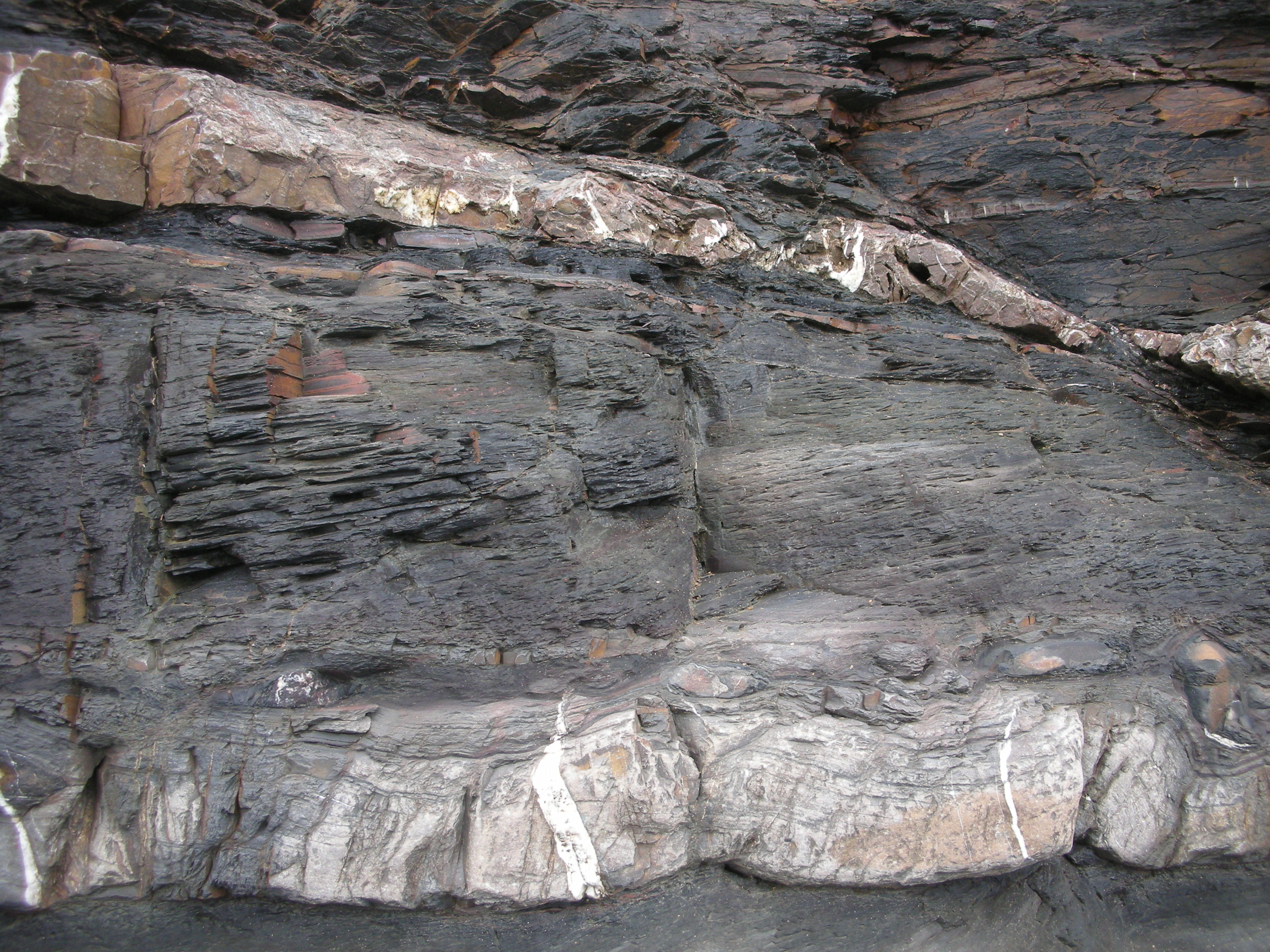
To our right is a wall of undulating sandstone strata, reaching up to over 700 feet, and to our left what appear to be giant sheets of rock, the dimensions of table tennis boards. These, says Jane, are  actually upside down (although I confess, I’d never thought of rocks being either one up or the other). But, 350 millions years ago, when Crackington Haven was in the middle of the Rheic Ocean, the European and African tectonic plates slammed against each other, pushing upwards and creating the mountains that have long gone, throwing unimaginable amounts of rocks over on to their backs.

At our feet are countless sandstone pebbles, nearly all criss-crossed with thin white lines, our guide explains  are quartz veins created when silica, was forced through fissures in the rocks by heated water at high pressure. The quartz veins are the residue. The small striations caused by tidal water swirling around pebbles.

We are staring at a old master of the carboniferous period (over 300 million years ago), with a scientist for a guide, unearthing its secrets; the tell-tale signs of geological evolution. Every pebble Jane holds up has a story: There are some with tiny indents; goniatites, the fossils of tiny marine animals; shale pebbles, also veined; and nodules, small rock cups, thought to have formed around shells, made from pyrite and frequently mistaken for gold.

The climax of the three hour tour is at the summit of the cliff, at the end of a narrow stepped path of flowering alexanders, gorse and wild garlic.  Gulls hang motionless at our sides, and below even lines of white topped waves wear away at the browny/orange ground beneath the topsoil. An accumulation of stones and rocks from further up the valley swept down during the last ice age. A process called ‘gelifluction’ says Jane.

The rain clouds that had threatened to ruin our walk have drawn back to reveal a clear spring morning, and an uninterrupted vista from Steppers Point, near Padstow, to Widemouth Bay. A line of coves, shingle ridges, fissures and sandstone faults.

Of course it wasn’t always like this. Two million years ago the county was six kilometers wider than it is today.

“This is an erosion coast,” says Jane,  “and we’re in the interstadial period, when the ice is retreating, and the earth is warming, and sea levels are rising. Helped along with the aid of human activity.”

We take a long last look before commencing our descent, reassured that people as level headed as Jane Anderson are looking out for all of this.

 Jane has other walks  at Polzeath, Duckpool to Sandymouth, Pentire Head and Boscastle. For details go to nationaltrust.org.uk – although not the world’s most user friendly site

Posted in Seashores | Leave a comment

A Sporting Chance

A few days ago I had a letter of mine read out on BBC Radio 4, although not for the first time. If it is at all possible I seem to be getting even more unhappy with the way the world is run as I get older, and I have sent several missives Broadcasting House in recent months, jabbing the email send tab with the same self satisfied flourish grumps from another age despatched stamped, hand written envelopes into the gaping mouths of letter boxes. That’ll give them something to think about. Maybe?

The remarkable thing is it did. The programme, You And Yours, was taking the nation’s temperature in the run up to the Olympic Games. Coming the week some athletes had revealed that they have not been allocated enough tickets for even the closest members of their families to see them in action. Meanwhile a survey discovered that less than half the population is excited by the prospect of the games. Fifty three per cent of respondents said they weren’t interested.

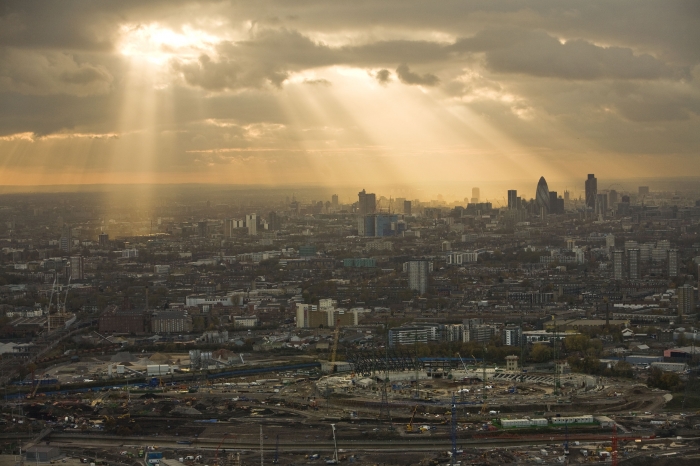
In the light of these, and other controversies, including the much touted post games infrastructure and sporting legacy, and the fact that the capital will be in gridlock for a month, the BBC had thrown the spotlight on what the event actually means to Londoners, and the population beyond the capital, as far flung as Wales, Scotland and Northern Ireland. The finding here were even gloomier. Ninety eight per cent said it had nothing to do with them, “all it does is spend our money,” chimed several.

“A monstrous vacuum cleaner sucking up resources to spend on real estate in London,” wrote someone from up north.

The other time a letter of mine was read out on air, in full, was when PM’s Eddie Mair, himself a bit of a wag, asked listeners what caused their depression? This is a subject I am becoming something of an expert on and the cause of my own was read out in full, just before the pips at six. 

My gripe this time was about the ticketing. I was pleased when London secured the games. We do big, national events well. And there isn’t much bigger than the olympics.

I still think fondly of Brian May, ten years ago, playing the National Anthem on the roof of the Palace, for the Golden Jubilee: younger readers note he was in a band called, Queen. Tickets would be expensive and the way we were instructed to apply for them beggared belief;  Allocating payment whilst agreeing not to know what events we would be going to until some time after the funds had been removed from our bank accounts. Steering clear of the big ticket events, that would surely be over subscribed, I applied for everything from sailing and rowing to a couple of track events. At what would have been a cost of about £1500, if I’d got them all. Nearly all of my friends pitched in for similar amounts. We didn’t apply for the 100m sprint or the opening ceremony. Our applications were more like each way bets, trusting that something in the lower orders would come good.

Some plan. I didn’t get one ticket, and neither did any of my friends. Out of six London families non of us would be going to the games. In fact, I haven’t met anyone with tickets. Later a number of corporations, Barclays among them, launched competitions with olympic tickets as prizes. The tickets Londoners had applied for were being used as a marketing tool. Next, to compensate for the miss selling of synchronized swimming events,  10,000 tickets, for alternative events, were conjured up and handed over by way of  compensation. Where had those tickets been? At the back of the filing cabinet?

The final slap in the face came with the ‘Test Events’  – events, held in advance of the games to see how the new facilities would shape up? We were asked to pay for these as well. Shouldn’t they have been free to the Londoners who applied, but failed to get to the real things?

It all leaves a bad taste in the mouth. So when You And Yours asked its listeners what they felt about the games a lot of us angrily booted up and hit ‘send’. It’s going to be like having the world’s greatest cocktail party in your own living room – except the door is locked and you can’t get in. Just  another TV event, I wrote.  And I seemed to have caught the pulse of the nation, because except for a few infant school teachers who write to say their little ones were besides themselves with anticipation (which is lovely) a slew of letters were read out extolling a level of detachment that flies in the face of the spirit of the games.

It all makes for entertaining radio, but it’s not got me any tickets for wrestling – Greco Roman, or archery. On the other hand a 54 inch flat screen television to hang on the wall will work out cheaper.

Posted in London | Leave a comment

Me, Cornwall, 13 women and Fulham Football Club

The first Cornish Beach I ever stood upon was Mawgan Porth, on the north coast, roughly mid-way between Padstow and Newquay. It was 1978 or 79, and I remember the tall cliffs at both end and the white tessellated holiday homes crammed into the dark vertiginous cliff walls. There is a photograph of me somewhere with black hair, wearing a red and black checked shirt. I think I may even be sporting a moustache.

These days Mawgan Porth is popular with surfers, and there’s a fashionable new hotel called The Scarlet, boasting a ‘green’ holiday agenda.

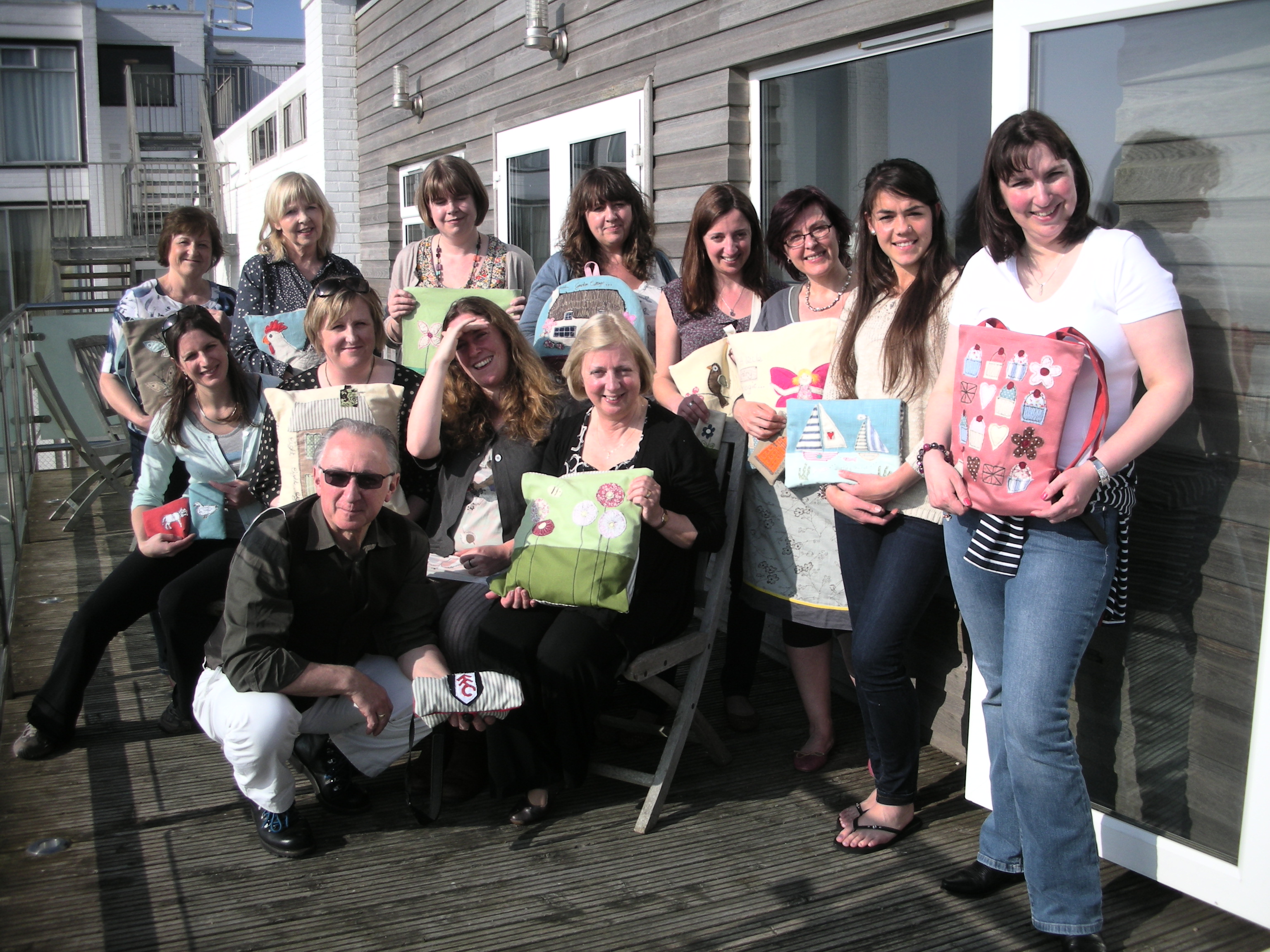
I was back there again the other week, for two nights at the low and sprawling Bedruthan Steps Hotel, enrolled on to an embroidery weekend with a group of women who share a passion for Cornwall and sewing. I should add, my stay wasn’t out of choice. It was a commission for a newspaper who wanted a man to spend some time learning girlie stuff. A female writer was handed a more manly assignment.

The women in the group all came with ideas of what they wanted to make. Most planned cushion covers, bags, or wall hangings, that they planned to embellish them with machine embroidered – motifs; furry animals, flowers, toadstools and the like. Pressed on what I would do with my time I suggested something more practical – a camera case with a hand sewn Fulham Football Club badge on the flap.

The course is run by Poppy Treffry, the surname pronounced with an emphasis on ‘fry’ as in fish fry. She’s very Cornish. She grew up in a two up two down on Bodmin Moor, but got herself through art school and now runs an embroidery/textile business in Penzance.  I knew she was true Cornish when she told me she’d ordered steak at the hotel’s seafood restaurant. I’ve never met a Cornish person yet who eats fish.

Poppy has boundless enthusiasm. She taught me how to thread and use a sewing machine in the time it takes me to press a pair of trousers. While keeping an eye on what the others were doing she showed me free-hand embroidery: it’s not easy. I found the first day difficult. I kept snagging the machine. I broke two needles and cut myself.

The second day was better, and by late afternoon I’d embroidered an FFC badge in red, white and black, and following Poppy’s instructions, sewn a bag, also in team colours.

Take a look and see what you think? 

The Bedruthan Steps Hotel has a range of courses, from sewing to bread making and basket weaving, throughout the year. They’re good value too. Mine was £324 for the course, accommodation, all meals and some of the best views in Cornwall.

Bedruthan Steps Hotel, Mawgan Porth, Cornwall/www.bedruthan.com

Poppy Treffry’s work can be found at www.poppeytreffry.co.uk and there is more about my weekend at the Bedruthan Steps Hotel on her blog http://poppytreffry.wordpress.com/

Posted in Seashores | 1 Comment

Dinner In Drummond Street

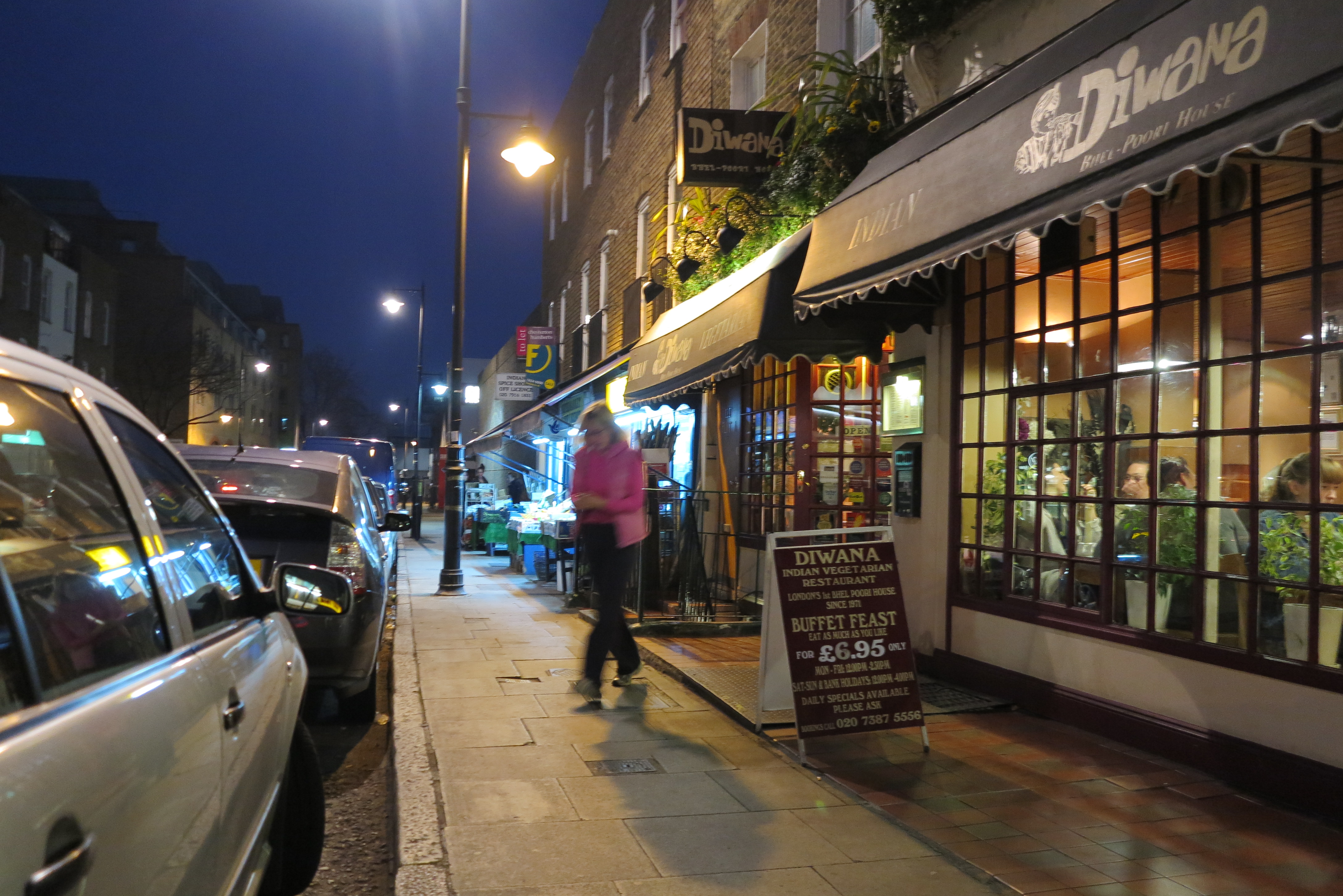
I am not a vegetarian, and I can take or leave Indian food – much of it in London seems indifferent, even a bit samey – but once in a while I like to pass by Drummond Street, just off the Hampstead Road, for a bag of mixed pakoras from the Ambala Sweet Centre, or for an inexpensive, meat free meal. There are a few places to choose from, but Kim and I tend to use the Diwana Bhel Poori House, beneath a fancy brown awning at the eastern end of the street.

I think if were to live more centrally I’d like to be on or just off Drummond Street. Like the eye of a storm there is calmness to the place, and unlike the West End where the air is muggy with the scent of overused fat, the air in Drummond Street is lightly spiced. And because few buildings are higher than three storeys, the sky is big, and at night, speckled with the lights of nearby office blocks.

Drummond Street is a world within a world. Another London, turning at its own speed on a different calendar. It’s been this way for as long as I can remember. All of which will change, and maybe not for the better, if proposals for the High Speed 2 (HS2) go ahead.

If you don’t already know the £33 million HS2 project, that will, boast its proponents, snip 30 minutes off the journey time by train between Euston and Birmingham, will cut a swathe of destruction through Camden Town. It looks certain to cause the demolition of over 250 homes in the Regents Park Estate, mostly on the western side of the Hampstead Road, and to accommodate an expanded Euston Station the London terminus of HS2 will devour all, or most, of Cardington Street, and crucially about 20 per cent of Drummond Street.

The scale of the project was described by the local Member of Parliament, Frank Dobson, as of another St.Pancras International.

 Many, who have lived along the proposed route, and will have to be rehoused, are traumatised.  Especially those who bought their council flats and who are faced with having to leave the area altogether owing to the value of their property, if compulsorily purchased, not being enough to pay for alternative accommodation in Camden Town. The council is fighting the proposals, and there is a long way to go.

Being mindful of the plans gave my trip there a different perspective. Some of the street will go forever, and the Diwana Bhel Poorie House will find itself cheek-by-jowl with a new mainline railway station.

You wouldn’t know of any of this to judge from the smiling faces within the restaurant. Boasting on its Facebook page that it is open 364 days of the year it is always packed with an assortment of office workers, hippie families with noisy children, student types, and the sort of old school fourth age leftie who would probably knit their own footwear given half a chance. Kim, Rob, Debs and I shared two plates of Bhel Poori, the spicy, crunchy starter made with puffed rice and chutney. For their main courses they each ordered those vast dosa pancakes, rolled into tubes that hang off the edges of plates, and stuffed with spicy potatoes. I went for a thali, which is a selection of rice, vegetable curry, dhal and chapattis.

Diwana isn’t licensed and so most people nip next door to the spice shop and off licence. It’s where Kim buys her spices for our curries, at a fraction of supermarket prices.

What did the man with the heavy bottom lip and the wavy white hair at the till think of the HS2 plans? “If it happens, it happens,” he said with a resigned shrug.

Was he worried? Are people in the street worried? “Yes, they are,” he said looking me in the eye, perhaps forlorn with all the talk. “We’ll have to see.”

Posted in London | Leave a comment

do dogs dream?

Tashi Delek isn’t very old, she’ll be 12 this coming June, but that’s a good age for an Airedale Terrier, or any big dog, and she’s beginning to show her age.

She is in pretty good shape, maybe a bit thin around the flanks (getting her to eat two meals a day has never been easy), but she’s kept her black ‘saddle’ and hasn’t succumbed to that salt ‘n pepper beard, the tell tale sign of many an aging pooch.

It’s her legs that are the principal cause for concern. They’re letting her down. This morning the hind pair buckled as she went through the garden door. She did the splits, and was visibly shaken. The front ones often go too, if she’s had to make a sudden change of direction, or the ground under paw is a bit damp and slippery. When it happens it saps her confidence, and invariably she’ll turn and head for home, scraping her paws every other step, a sign that she isn’t lifting them adequately.

A few years ago a vet in Cornwall diagnosed arthritis in one of her front legs, and prescribed Rimadyl. She’s taken one 50mg tablet every day since then, and she’s been much improved. I don’t know what they put in them, but apart from Bonios, cheese, chicken and chocolate, it’s just about the only thing we can get down her without any kind of coercion.

With her tale erect she’ll go for short walks, of sorts. More long, distracted plods, punctuated with dozens of diversions; a twig here, a bush there, and long stationary looks toward some unknown point in the distance, as if she were on some sort of surveillance. Walks that a man on crutches could achieve in 20 minutes can easily last well over an hour with Tashi.

She does have some reserves of energy, in storage for emergencies like squirrels, postmen, and moving tennis balls. At these times she can cover short distances at a creditable sprint. Thereafter plodding, even slower than before, her energy levels depleted, but with a look of satisfaction on her furry face that only Kim and I can recognise.

It is a fact that dog owners often speak to other dog owners. I am not referring to the groups of dog people you often see huddled together, deep in conversation, while their dogs wonder what’s going on. Rather the off-the-cuff remarks other owners feel obliged to make, as if the very fact that both you and they have a dog is membership to some secret canine society that does away with normal British reservedness. In much the same way that motorcyclists nod and acknowledge one another.

To this end many people I would never normally communicate with feel duty bound to comment upon Tashi’s age, and general feebleness. “Oh, bless,”  they’ll say, and, “she’s doing well for an old ‘n”. It’s a kindness, of course. They really do care, because they know how short a dog’s life is. As Hugo, a stooped former military man in Padstow remarked, with a tear in his eye, after his best friend died a year ago, “it’s not fair, their lives are too short.”

I daresay the man sat by the fire at The Lamb Inn, in the Wiltshire village of Hindon, felt the same way, as Tashi stumbled down the short flight of steps into the pub, looking dazed. He looked a bit like Nigel Bruce, whom some may know as Dr.Watson in the original Basil Rathbone Sherlock Holmes mysteries. His wife remained silent as her husband, in tweeds and brogues, inquired as to Tashi’s age?

“Eleven eh,” he said, leaning forward. “It’s a terrible thing when they have to stick the needle in, and it’s all over.” Upon hearing that his wife, the size and features of a small bird,  stunned, by her husband’s tackless candor, wrestled with his arm and extracted an apology of sorts.

Of course, he meant nothing by it, the old fool. But since then I’ve been just that little bit more attentive of Tashi. She’s on the sofa now. Lying on her back with her legs in the air, one out straight like a Nazi salute. I wonder if she knows she’s old? Or maybe she just thinks the squirrels are getting faster.

Posted in Dogs, Uncategorized | 2 Comments

Kim’s Work On Sale In Fowey

This week Kim secured a second outlet for her painted and embroidered beach scenes, that until now have only been available through Sarah Adams’ Padstow Studio. Henceforth Kim’s work will be showcased at the Fowey River Gallery, a large, two floor space, right in the heart of town, moments from the water’s edge, on Fore Street.  It’s a fine gallery, with high ceilings, and plenty of natural light, and lots of work, much of it by local artists. I have a hunch Kim will do well there, for the simple reason that her pictures are so beguiling. Beautifully executed they captivate everyone who takes the time to explore her charming vignettes of Cornish beach life: the paddlers and picnickers, the surfers and sand castle builders, the dog walkers and daydreamers.

It’s been a while since I spent any time in Fowey, a handsome town, with ginnels, fine pubs, and views at every turn. My friends Pat and Bruce had a tall house by the water’s edge, with a terrace where Pat, with a glass of wine in her hand, spent many hours craning her neck to count the stars. I was fond of the long, up and down, often muddy trek from Polruan, on the other side of the harbour, through the woods to the old jetty at Pen Pol. Then the long slog up around the headland and down to The Old Ferry Inn by the Bodinick Ferry. It had rained so much one time we left puddles on bar floor.

I returned to Fowey last spring to research a piece for The Sunday Times on the town, published to coincide with the Daphne du Maurier Festival. I showed Kim some of the places I’d been taken too, after we’d dropped off three of her pictures with Kevin, owner of the Fowey River Gallery. He seemed happy for Kim to concentrate her skills on the north coast’s beaches, notably Constantine, Harlyn and Padstow’s Harbour Cove, the settings of much her work to date. Nevertheless Kim aims to give her new gallery some images closer to its home. With that in mind we drove down to Readymoney Cove, at the western edge of Fowey, where, beneath a clear early spring sky, Kim took photographs, and got the lay of the land.

Before we left the area we took the lane, about a mile outside Fowey, off the Par road, that runs alongside Menabilly, the house and estate where du Maurier wrote many of her stories. Last year I’d asked a couple of local people, one a farmer and  another walking two black labs, if one could see the house from road. I got the impression they don’t like people asking that question. The house remains an enigma, deep in a thicket of trees. Next time we’ll park up and follow the path to the beach.

Fowey River Gallery, Fore Street, Cornwall, PL23 1AQ. 01726 833828/foweyrivergallery.co.uk

The Padstow Studio, 30 Duke Street, Padstow, Cornwall, PL28 8AB. 01841 533777/padstowstudio.co.uk

Posted in Seashores | 1 Comment